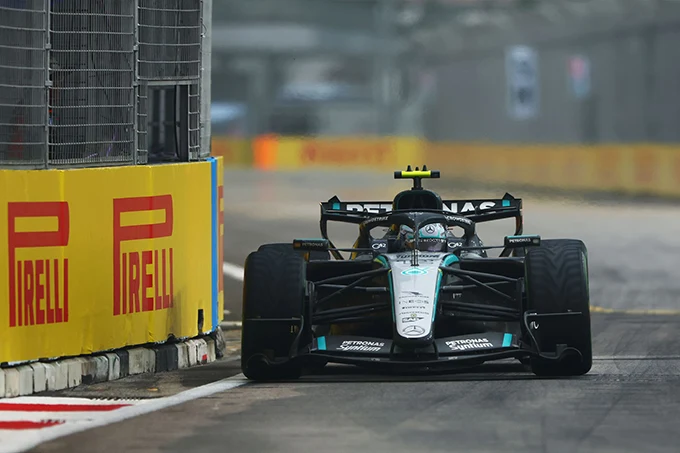
Mercedes believes it has identified why its latest W17 upgrades failed to deliver their expected gains at Sepang, with a revised aerodynamic package and new front wing set to feature on both cars at the United States Grand Prix.
Mercedes is preparing to run both its cars with the latest aerodynamic upgrades at Austin after an extensive investigation revealed that its revised W17 was generating additional downforce but struggling to translate that improvement into consistent performance.
The German team introduced a new floor and substantially redesigned bodywork at the Bahrain Grand Prix, unusually held at Malaysia’s Sepang International Circuit. Although the car remained competitive, the anticipated performance gains did not fully materialise.
Rather than abandon the package, Mercedes conducted a direct comparison between its old and new specifications during the Singapore Grand Prix weekend, using George Russell and Kimi Antonelli to establish where the development programme had diverged from expectations.
The findings have given Mercedes a clearer understanding of the car’s aerodynamic balance and informed its decision to introduce a new front wing alongside the upgraded package at Austin.
Mercedes Used Singapore to Compare Both W17 Specifications
At Singapore, Antonelli retained the aerodynamic developments introduced at Sepang, while Russell reverted to the previous specification with which he had won the Azerbaijan Grand Prix in Baku.
Russell supported the decision and had encouraged the team to conduct the comparison, recognising the opportunity to investigate potential weaknesses in the new package.
The British driver’s weekend was already compromised by a grid penalty resulting from the replacement of power-unit components, making the timing particularly suitable for an experimental approach.
Speaking on Mercedes’ internal Nu Silver Arrows Radio Show podcast, deputy team director Bradley Lord explained that the decision was influenced by both the need for immediate technical answers and the financial limitations imposed by Formula 1’s cost cap.
Mercedes could have continued investigating the discrepancy through factory simulations and aerodynamic development, but a direct comparison on track offered a faster and more economical way to gather evidence.
Lord said the team had used components from its existing inventory to return Russell’s car to the older specification, allowing the two configurations to run alongside one another in representative conditions.
The experiment was particularly valuable because some of the characteristics observed at Sepang had not matched the team’s predictions or had fallen outside the range of behaviour its wind-tunnel and simulator tools could reliably anticipate.
Although Singapore was a Sprint weekend, with limited practice time, Mercedes considered the exercise worthwhile.
Lord also stressed that operating within financial restrictions is now a permanent feature of Formula 1 development and that every team faces the same challenge of maximising performance within those limits.
Sepang’s Unusual Conditions Complicated the Upgrade Assessment
Mercedes deputy technical director Simone Resta explained that the characteristics of Sepang had made it difficult to establish whether the aerodynamic package was fundamentally underperforming.
The Malaysian circuit features distinctive asphalt, high ambient temperatures, rapidly changing weather conditions and particularly severe tyre degradation.
Those factors made Sepang an unusual reference point for assessing the performance of new components.
Resta cautioned that the behaviour of a car at such a circuit cannot automatically be assumed to represent its performance at other venues.
Mercedes left Malaysia believing its W17 remained competitive, but without having observed the improvement predicted by its simulations.
That uncertainty prompted the team to arrange an immediate comparison rather than wait several races for further evidence.
Resta said the quickest way to resolve the question was to conduct a practical test at the next available opportunity.
According to the Italian engineer, the Singapore experiment provided the information Mercedes had hoped to obtain.
He also praised Russell’s willingness to participate, describing the driver’s decision to volunteer for the comparison as an example of his commitment to the team’s wider interests.
More Downforce, but an Unexpected Shift in Aerodynamic Balance
The Singapore investigation established an important distinction: Mercedes’ latest upgrades were producing additional aerodynamic downforce, broadly in line with the team’s expectations.
The difficulty was not necessarily the amount of downforce generated, but how that performance was distributed across the car.
Resta revealed that the revised aerodynamic package had strengthened the front end more than anticipated, changing the overall balance of the W17.
As a result, the team needed to adjust the operating window of the car to make effective use of the additional aerodynamic performance.
This process requires track running, comparisons and setup development, all of which are difficult to complete during a Sprint weekend.
Singapore presented further complications.
With only one free practice session before Sprint qualifying, Mercedes had little time to evaluate the different configurations before the cars entered competitive sessions.
Wet conditions during the Sprint added another variable, while the subsequent Grand Prix qualifying session left limited opportunities for further experimentation.
Resta noted that although the weekend was lengthy in terms of elapsed time, the number of useful laps available for technical analysis was relatively small.
Mercedes therefore had to accelerate its learning process and extract as much information as possible from the limited running.
Antonelli Tested a New Front Wing During Singapore Practice
Mercedes also used Singapore’s sole practice session to evaluate a new front wing.
The component was fitted to Antonelli’s W17 during FP1, before the Italian returned to the previous front-wing specification for the remainder of the weekend.
The experiment was intended to provide an additional comparison and improve Mercedes’ understanding of how the latest aerodynamic developments interact.
With Russell already running the older overall specification, testing the new front wing on Antonelli’s car allowed the team to gather another set of data within the same limited practice window.
Resta explained that Mercedes had deliberately accelerated its evaluation programme to obtain information relevant to both its immediate performance and medium-term development.
The team never intended to race the new front wing in Singapore.
Instead, engineers wanted to assess its behaviour, compare it with the previous design and return the resulting data to the factory for further analysis.
That work would include additional simulations and simulator running before the next Grand Prix.
Resta characterised the exercise as an investment in the team’s future understanding of the W17, rather than simply an attempt to resolve the difficulties encountered in Malaysia.
Why Mercedes Did Not Race the New Front Wing in Singapore
The decision not to retain the new front wing for Sprint qualifying, the Sprint or the Grand Prix was also influenced by component availability.
Lord confirmed that Mercedes had brought only one example of the new design to Singapore after accelerating its production.
Running a unique component throughout the competitive sessions would have introduced a significant operational risk.
Damage to the wing could have forced the team into changes that might have required a pit-lane start.
Mercedes therefore concluded that the potential benefits did not justify the risk of using the component beyond practice.
Nevertheless, Lord said the limited test had delivered valuable information and could help the team arrive at Austin with a more effective configuration.
Both Mercedes Cars Set to Receive Full Upgrade Package at Austin
Mercedes now plans to equip both Russell’s and Antonelli’s W17s with the latest aerodynamic specification, including the new front wing, for the United States Grand Prix.
The team believes the lessons from Singapore will allow it to exploit the additional performance potential identified in the revised package.
Lord expressed hope that the information gathered during FP1 and the comparison between the two car specifications would translate into an immediate improvement at Austin.
The objective is not simply to generate more downforce, but to make the higher level of aerodynamic performance accessible and usable across the car’s operating range.
Mercedes has already established that its latest developments offer greater theoretical performance. The challenge is to ensure that the balance and setup of the W17 allow its drivers to benefit from those gains consistently.
Austin will therefore represent an important test of the team’s revised understanding.
After an inconclusive debut for the package at Sepang and an intensive experimental weekend in Singapore, Mercedes will finally have the opportunity to evaluate its combined upgrades on both cars.
Whether that produces the expected improvement remains to be seen, but the team believes it now has a clearer explanation for the discrepancy between its simulations and its initial track performance.