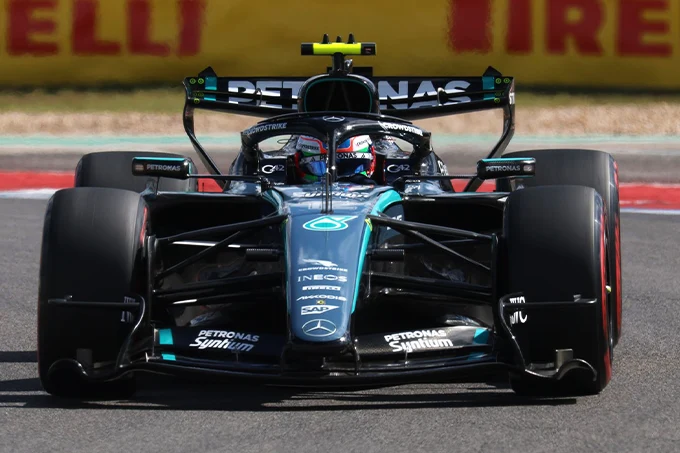
Kimi Antonelli’s commanding victory in Austin proved the peak potential of the upgraded Mercedes W17, yet George Russell’s 50-second deficit exposed a baffling performance gulf. Since introducing its major aerodynamic package in Malaysia, the team has grappled with a much narrower operating window. While continuous running helped Antonelli master the car, Russell’s return to the older specification in Singapore hindered his adaptation, leaving Toto Wolff’s squad determined to widen that sweet spot for 2027.
Kimi Antonelli’s triumph at the Circuit of the Americas has not entirely dispelled the question marks hanging over the major upgrade package introduced on the Mercedes W17 in Malaysia. While the Italian extracted the maximum from his machinery in Austin, George Russell endured a vastly more complicated weekend, taking the chequered flag more than 50 seconds adrift of his team-mate.
That gulf in performance-unexplained by any specific race incident or external circumstance despite both drivers running identical specifications-highlights the challenge facing the German marque. While the new aerodynamic package has raised the car’s ceiling, its operating window appears to have narrowed considerably. Team principal Toto Wolff readily admits the updates have not delivered instant, plug-and-play results, but Mercedes remains committed to this development path, fully aware of its critical implications for the design of its 2027 challenger.
From Sepang doubts to a split-spec experiment
Mercedes believed it had taken a major stride forward with the W17 when it introduced a substantial bundle of upgrades at the Malaysian Grand Prix. The product of several months of factory work, the Sepang package marked the team’s largest single development push since the updates brought to Montreal earlier in the season. Unlike rivals that favour a steady stream of minor, incremental tweaks, Mercedes opted to group its aerodynamic developments into one comprehensive step.
Initial trackside feedback, however, fell short of expectations. In Malaysia, the Silver Arrows struggled for both outright pace and consistency, even with Antonelli securing second place behind Max Verstappen. Unwilling to jump to conclusions given the unique characteristics of the Sepang International Circuit, the team elected to conduct a back-to-back comparison at the following round in Singapore.
On Russell’s own initiative, the two garages split their configurations at Marina Bay: Antonelli retained the Malaysian upgrade package, while Russell reverted to the older, better-understood specification to help engineers isolate the behavioural differences and pinpoint the root cause of their struggles.
By the time the paddock arrived in Austin, Mercedes opted to fit the new package to both cars. Speaking ahead of the US Grand Prix weekend, Wolff stressed that unlocking these updates was vital not only for the remainder of the W17’s campaign, but also to validate the team’s blueprint for 2027.
“I think this new car requires a very different set-up philosophy to the previous car, and that is what we are currently learning,” Wolff explained prior to track action in Austin. “Does it deliver the performance we hoped to get with this upgrade? I don’t think so yet, but it was a step in the right direction. In Austin, we will see if we can continue to consolidate that and if, in fact, it delivers more performance, because that is crucial for next year’s development direction.”
A knife-edge operating window
The United States Grand Prix ultimately delivered a stark demonstration of just how sensitive the upgraded W17 is to driver preference and set-up direction. Antonelli dialled his car in to perfection, claiming pole position on Saturday before controlling Sunday’s race from the front. Russell, conversely, never looked comfortable, languishing nearly a minute behind by the finish.
To explain the disparity, Russell suggested that the latest updates have significantly shrunk the W17’s sweet spot. In essence, while the car is now capable of reaching a higher peak performance level, it only does so when its mechanical and aerodynamic balance is tailored with pinpoint accuracy to both the circuit’s demands and the driver’s inputs. Missing that window by a fraction results in a severe drop-off in competitiveness-a trait reminiscent of the headaches Red Bull suffered with its RB20 and RB21 machines under the previous regulatory cycle.
For Wolff, the rollout of the Malaysian package cannot yet be classed as a clear-cut triumph. In the Austrian’s view, a truly effective upgrade should yield tangible lap-time gains straight out of the box without demanding a protracted adaptation phase.
“I think a successful upgrade is something like what we had in Montreal: you bolt it onto the car, the driver tells you it works, and you feel it immediately,” Wolff noted. “It brings gains in the area where you focused your development, whether that’s in high-speed or low-speed corners.”
Although the Sepang specification failed to meet that standard initially, Mercedes is standing firm, guided by its simulation tools and underlying aerodynamic data. Wolff drew a direct parallel between the team’s persistence with the upgrade and its bold, race-winning call to commit Antonelli to a one-stop strategy on Sunday in Texas.
“This upgrade didn’t work at first and, like on Sunday, we stayed true to our strategy and our data, which made the one-stop strategy the race-winning one,” added Wolff. “I think we are currently doing the same thing with this upgrade. Our data shows us that the car has the aerodynamic downforce. Our data shows us where the weaknesses lie, but it has also been our development direction for three and a half months. So we are continuing in this direction and trying to fix the elements that aren’t working as they should.”
Rather than questioning its overarching concept, Mercedes is convinced the theoretical performance is embedded within the car; the challenge now lies in making that downforce accessible across a much broader range of track conditions.
Why Antonelli unlocked the W17 faster than Russell
According to Mercedes deputy technical director Simone Resta, a key factor behind the contrasting fortunes of the two drivers lies in the continuity of their respective run plans over the past three grands prix.
While Antonelli has driven exclusively with the new package since its introduction in Malaysia, Russell’s switch back to the older baseline in Singapore interrupted his rhythm-complicating both his own adaptation and his engineering crew’s search for an optimal set-up direction upon returning to the upgraded spec in Austin.
Addressing Russell’s difficult afternoon in the team’s post-race debrief, Resta acknowledged the toll of the car’s narrower working range.
“Unfortunately, it’s another slightly frustrating weekend for George, and it simply shows how close the gaps currently are between all the teams, as well as how much the car’s operating window has narrowed slightly recently,” Resta explained.
“How did Kimi manage to unlock that potential in Austin? In reality, it was a long process. It all started in Malaysia, when Kimi ran the upgrades, then he kept them in Singapore and again in Austin. Lap after lap, session after session, he was able to understand, progress, learn and, ultimately, he managed to put it all together, both on his qualifying lap and during the race.”
Resta was quick to point out, however, that Antonelli’s victory did not mean the W17 had suddenly transformed into a compliant, easy-to-drive machine. Even on his way to the top step of the podium, the young Italian had to manage a delicate balance throughout the grand prix.
“The balance of the car during the race was tricky for Kimi. He mentioned it after the finish, but that wasn’t a characteristic unique to him. It was the case for all the drivers,” Resta continued. “We heard a lot of comments from every driver on the radio or after the race, and Kimi managed to look after the tyres in the right way, keep them in their operating window, make no mistakes, and extract the maximum from what he could get on the day.
“I think there is a very good spirit within the team, and this is clearly a very important victory for us. We saw Kimi deliver an exceptional performance, so everyone is very excited about that.”
Retracing the Austin breakthrough ahead of Mexico
As attention shifts to the Mexican Grand Prix, Mercedes’ immediate priority is to forensically analyse how Antonelli and his engineering side of the garage transformed their weekend in Texas.
The W17 had looked far from its best during Friday practice in Austin, before a methodical series of overnight changes propelled Antonelli to pole position on Saturday and race victory on Sunday. For Wolff, reverse-engineering that progression is the final piece of the puzzle required to make the car a consistent frontrunner.
“I think the upgrade we put on the car is tricky to exploit. I think he [Antonelli] managed to find the right formula,” concluded Wolff. “We are going to try to trace back every single decision we made and correlate it with the lack of performance on Friday, and then the relative outperformance on Saturday and Sunday. But at least the good news is that the car works. Now it’s about widening its operating window.”