The former Formula 1 driver reflects on the pressure of winning in Monaco, the emotions of his first Grand Prix victory, his unfulfilled championship ambitions and how an Australian joke became one of F1’s most recognisable traditions.
Daniel Ricciardo has opened up about some of the defining moments of his Formula 1 career, revealing the intense anxiety he experienced before winning the 2018 Monaco Grand Prix and admitting that his obsession with becoming world champion prevented him from fully appreciating his achievements.
The Australian, who left Formula 1 following the 2024 Singapore Grand Prix, spent 14 years competing at the highest level, recording 257 starts, eight victories and 32 podium finishes.
Yet despite establishing himself as one of the sport’s most recognisable personalities, Ricciardo never achieved the ambition that had driven much of his career: winning the Formula 1 world championship.
Having made his debut with HRT in 2011, Ricciardo progressed through Toro Rosso before joining Red Bull alongside Sebastian Vettel in 2014. His subsequent victories with Red Bull and McLaren demonstrated his ability to compete at the front, while his personality and distinctive celebrations helped establish his popularity among fans.
In a new interview with Formula 1, Ricciardo revisited the victories, disappointments and personal experiences that shaped his career, beginning with a Monaco triumph that proved considerably more emotionally demanding than he had anticipated.
Monaco 2018: The victory Ricciardo wanted to get over with
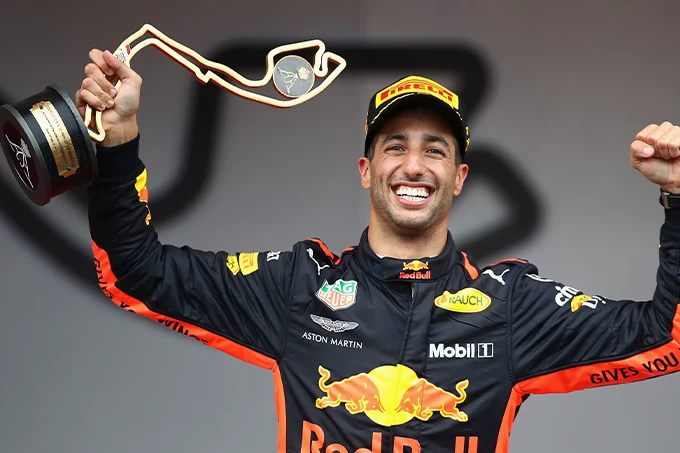
For Ricciardo, winning the Monaco Grand Prix in 2018 represented more than another addition to his Formula 1 record.
Two years earlier, he had secured pole position in Monte Carlo and appeared destined for victory before a disastrous pit stop deprived him of what would have been one of the biggest achievements of his career.
When another opportunity arrived in 2018, Ricciardo once again qualified on pole. However, rather than approaching the race with excitement, he found himself overwhelmed by the possibility of suffering another disappointment.
“I haven’t won 100 races,” Ricciardo recalled.
“I’ve won eight, so they’re all very special. But yes, there was even more at stake than in 2016. I think having another opportunity to win Monaco made the pressure even greater.
“I just wanted it to be over. I wasn’t looking forward to the race.”
Starting from pole position around the streets of Monaco is normally an occasion for anticipation and confidence. For Ricciardo, however, the build-up had become something he simply wanted to escape.
He remembered struggling with a lack of sleep and feeling increasingly uncomfortable as people approached him with encouragement and advice before the start.
“Nothing excited me. I was just thinking that I’d barely slept. Everyone was coming up to me to wish me good luck and trying to give me advice.
“I just wanted to go and hide, finish the race, hopefully win, and then go and have a drink!”
His concerns were understandable given what had happened two years earlier, but the 2018 race would produce an entirely different challenge.
Although Ricciardo established himself at the front, his Red Bull suffered a significant loss of power while he was leading.
With Sebastian Vettel pursuing him in the Ferrari, the Australian was forced to manage a compromised car for much of the Grand Prix.
Red Bull engineers attempted to guide him through the problem remotely, providing instructions on settings and adjustments that could help him maintain sufficient performance to remain ahead.
Looking back, Ricciardo admitted that he did not fully understand the severity of the mechanical issue at the time.
Paradoxically, he believes that limited understanding may have helped him remain focused rather than become overwhelmed by the scale of the problem.
“At that point, because of some gaps in my understanding of how Formula 1 cars, engines and all those hybrid systems worked, I didn’t really know what the problem was.
“I probably should have known, but if I had, I think I would have realised just how much worse the situation actually was.”
The problem substantially reduced the performance available from his Red Bull, particularly in a race where maintaining momentum and protecting track position are crucial.
Ricciardo explained the consequences in terms of the gears he could use around the Monte Carlo circuit.
“Formula 1 cars have eight gears. At Monaco, because the straights are shorter, you don’t really get into eighth anyway, so you’re already only using seven.
“With this problem, I was only using six, so I had a lot less power.”
Rather than receiving a detailed technical explanation of the failure, Ricciardo concentrated on the instructions being relayed from the pit wall.
He recalled being told to change settings, including moving the brake bias forwards, as his engineers worked to minimise the impact of the issue.
“I would explain it to the team, and they would simply give me instructions, like moving the brake bias forwards, doing this or that.
“It was just about solving the problems. They weren’t really explaining to me in detail what was wrong.”
Despite the mechanical difficulties and Vettel’s sustained pursuit, Ricciardo held on to secure his long-awaited Monaco victory.
The result finally erased the disappointment of 2016 and gave the Australian one of the defining moments of his Formula 1 career.
His celebrations included a memorable plunge into the swimming pool, although the relief of finally winning had been preceded by an extraordinary amount of anxiety.
For Ricciardo, Monaco remains one of his greatest achievements. Yet when reflecting on the emotions of winning, another race occupies an equally important place in his memories.
Canada 2014: An unexpected first victory and an unforgettable feeling
Ricciardo’s maiden Formula 1 victory came at the 2014 Canadian Grand Prix, during his first season with Red Bull.
The race in Montreal unfolded in dramatic circumstances as the dominant Mercedes cars of Nico Rosberg and Lewis Hamilton encountered almost identical electronic problems that affected the power available from their hybrid systems.
Hamilton, who had started second, eventually retired because of a braking problem, while Rosberg continued with reduced performance.
Ricciardo, meanwhile, had started from sixth on the grid.
After overtaking team-mate Vettel during the second sequence of pit stops, the Australian began closing on Rosberg’s struggling Mercedes.
On lap 68, Ricciardo made his decisive move at the entry to the final chicane, taking the lead and putting himself in position to claim his first Grand Prix victory.
He crossed the finishing line approximately four seconds ahead of Rosberg, bringing Mercedes’ winning sequence in the early stages of Formula 1’s turbo-hybrid era to an end.
The achievement was significant not only because of the result, but because of the emotions it produced.
Rewatching footage of that afternoon, Ricciardo remembered struggling to express himself over the team radio after finally becoming a Formula 1 race winner.
“I didn’t really know what to say. I think it was a very youthful laugh, a mixture of shock and joy, on the radio,” he explained.
The podium celebrations provided another vivid memory, particularly Vettel’s enthusiastic use of champagne.
“And in the final image, the one on the podium, I remember Seb, I think, spraying me with so much champagne that I was struggling to breathe.”
The images still provoke a powerful emotional response when Ricciardo looks back on them.
“I was thinking, ‘I need to breathe.’
“The first emotion is… I don’t know, is nostalgia an emotion? I don’t know.
“It all feels so familiar, but at the same time so distant. I’m also just incredibly grateful that I got to experience that feeling.
“It’s the absolute pinnacle of emotions in this sport.”
While Monaco represented the fulfilment of a long-standing objective, Canada was the moment Ricciardo first experienced what it meant to win at Formula 1’s highest level.
That feeling stayed with him, even if his pursuit of an even greater achievement would later influence the way he judged his career.
Why the absence of a world title overshadowed his achievements
Despite winning eight Grands Prix, Ricciardo admitted that he spent years struggling to consider his Formula 1 career a success.
The reason was his determination to become world champion.
For much of his time in the sport, he believed that winning the championship was the achievement that would ultimately justify the effort he had invested.
Without that title, his individual victories and memorable performances did not always feel sufficient.
“Beyond that, there is winning a world championship,” Ricciardo explained.
“For many years, I didn’t feel that my career was a success because the world title was something I was so focused on and believed in so strongly.”
His reflections reveal how the pursuit of a single ambition shaped his assessment of everything else he accomplished.
Even victories at circuits such as Monaco and Montreal could not entirely compensate for the championship that remained beyond his reach.
However, time away from Formula 1 has allowed Ricciardo to reassess those expectations.
Rather than continuing to judge his career primarily by the title he never won, he now recognises the significance of the experiences and achievements he accumulated along the way.
“But I think now, looking back, I say to myself, ‘OK, it was still pretty incredible to have experienced moments like those.'”
That change in perspective has given Ricciardo a greater appreciation of his eight Grand Prix victories and the emotions associated with them.
And while his championship ambitions were never fulfilled, some of those moments also produced celebrations that became almost as memorable as the races themselves.
The night Montreal celebrated, and Ricciardo went to bed early
Ricciardo’s first victory in Canada was followed by an evening of celebrations with his Red Bull team.
Rather than immediately leaving Montreal, the Australian and members of the team cancelled their scheduled flights to make the most of the occasion.
“We all had flights booked for that evening, which we very happily cancelled,” Ricciardo remembered.
The celebrations took place partly at a rooftop bar, where the team gathered after the race.
However, despite having just achieved one of the most important victories of his career, Ricciardo discovered that the emotional and physical demands of the day had left him with little energy.
“There was a bar, some sort of rooftop bar at the hotel. Yes, we just drank and caused a bit of a disturbance up there.
“But I have to say, I think the adrenaline eventually wore off, and I remember that at some point, I don’t know, maybe around one in the morning, I completely crashed.”
Rather than being among the last people celebrating, the newly crowned Grand Prix winner was one of the first to call it a night.
“In fact, I was one of the first to go to bed, but I heard a few stories the next day and saw some of the team members at breakfast.
“They didn’t look too good, but it was for a good cause.”
The episode captures a more personal side of Ricciardo’s career, combining the excitement of a breakthrough victory with the exhaustion that followed.
His willingness to celebrate and inject humour into the sport would eventually become one of his defining characteristics.
That reputation was reinforced by a podium ritual that initially began as a joke among friends in Australia.
How Ricciardo’s famous ‘shoey’ became a Formula 1 tradition
Few celebrations have become as closely associated with a Formula 1 driver as Daniel Ricciardo’s famous ‘shoey’.
The ritual, which involves drinking champagne from a racing boot, became a familiar sight during his time at Red Bull, Renault and McLaren.
Yet Ricciardo revealed that he had never intended for the gesture to become a worldwide phenomenon.
Its origins can be traced to the 2016 German Grand Prix, where he finished second and decided to drink champagne from his shoe on the podium.
The gesture was primarily intended as a message to friends watching back home in Australia.
“I really did it for my friends who were watching the race from Australia, and I knew they would message me afterwards saying, ‘You’re a legend. You did it for Australia.’
“I was being a bit of a bogan, someone who doesn’t take himself too seriously, I suppose.”
Ricciardo explained that the idea had already gained popularity among certain groups in Australia, including friends who had established a presence on social media.
“And there were friends and a group of guys in Australia who did it a lot and had quite a big presence on social media and all that.
“So it was becoming something that Australia, or part of Australia, was taking ownership of a little, and there were also Australian sportspeople and celebrities doing it.”
For Ricciardo, participating in the trend offered an opportunity to acknowledge his background and share a moment with those watching from home.
“So I thought, ‘OK, I want to be part of that and show Australia that I’m proud to be Australian.'”
However, the ritual also served another purpose.
Ricciardo had long felt that Formula 1 could be excessively serious, particularly when watching drivers who appeared unable to enjoy themselves even after achieving strong results.
The shoey became his way of introducing a different atmosphere to the podium.
“There was definitely a conscious element to it because the sport was still very serious,” he said.
“I would sometimes see drivers on the podium and they looked unhappy, and I didn’t really understand why.”
Ricciardo acknowledged that disappointment was understandable when a driver had narrowly missed out on victory.
“I can understand it if you lose the race on the final lap and finish second instead of first.”
However, he felt that Formula 1’s culture sometimes discouraged drivers from displaying enjoyment, even when they had good reason to celebrate.
“But there were a lot of situations where I thought the sport seemed a little too rigid, and that was also my way of trying to bring something different to it.
“I felt like the tie was choking everyone, and I thought, ‘Let’s undo the top button and relax a little.'”
What began as a spontaneous moment gradually developed into a tradition.
“And then it just became my thing, even though I hadn’t really planned to do it again.”
Over time, the shoey became one of the most recognisable elements of Ricciardo’s Formula 1 identity.
Its popularity eventually extended beyond the drivers and teams, attracting participation from personalities outside motorsport.
Patrick Stewart, Lewis Hamilton and a celebration that went beyond F1
One of the most memorable examples came after the 2017 Canadian Grand Prix, when British actor Sir Patrick Stewart, known for his roles in Star Trek and X-Men, joined Ricciardo in the unusual celebration.
Ricciardo recalled being surprised by Stewart’s enthusiasm, revealing that the actor had asked to participate before he had even received an invitation.
“I hadn’t even got to the point of asking him whether he wanted to do it,” Ricciardo explained.
“He was the one who asked me if he could do it, so basically he demanded it, and I thought, ‘This is really cool.’
“That was when I realised it had become quite a big thing.”
Even Lewis Hamilton, who initially expressed strong reservations about the idea of drinking champagne from somebody’s shoe, eventually took part.
The seven-time world champion had previously made his feelings clear.
“Juice from someone’s foot is not something I want to drink,” Hamilton had said.
Nevertheless, Ricciardo’s podium tradition ultimately proved difficult to resist.
“Lewis had also said one day that he would never do it, and then he did,” Ricciardo recalled with amusement.
For the Australian, there was satisfaction in seeing how far the ritual had travelled from its original purpose as a joke for friends back home.
“I’m just glad it was always my shoe. I gave people what they wanted.”
What began as a light-hearted gesture became an enduring part of Ricciardo’s Formula 1 story, reflecting the personality that helped make him a popular figure throughout his career.
And while the Australian never achieved his ultimate ambition of becoming world champion, his reflections on Monaco, Montreal and the celebrations that followed demonstrate why he now looks back on his time in the sport with a greater sense of appreciation.