Lewis Hamilton’s criticism of Formula 1’s electrical power deployment rules has prompted renewed discussions over potential changes for 2027, as the FIA faces the challenge of improving overtaking without compromising safety.
The FIA is reportedly prepared to review Formula 1’s electrical energy deployment restrictions for 2027 following concerns raised by Lewis Hamilton over the difficulty of overtaking under the current power unit regulations.
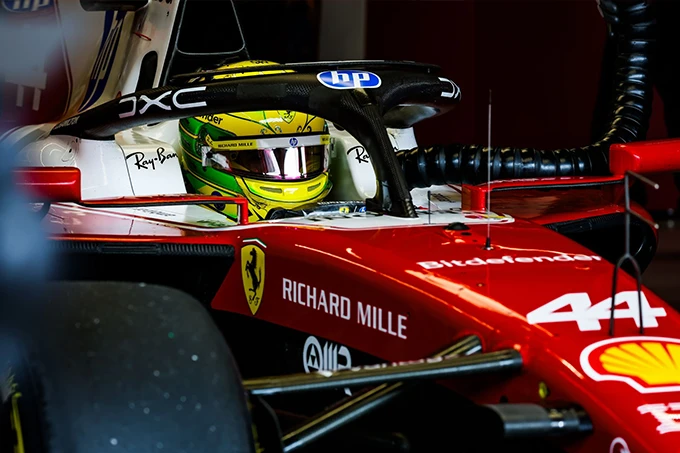
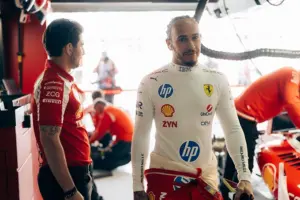
The Ferrari driver has criticised the way electrical power is progressively reduced at higher speeds, arguing that the restrictions prevent drivers from making full use of the slipstream when attempting to overtake.
The issue became particularly apparent at the Mexican Grand Prix, where Hamilton struggled to challenge Max Verstappen despite gaining an aerodynamic advantage along the circuit’s long main straight.
Just 13 overtakes were recorded during the race, the lowest figure of the 2026 season outside Monaco.
Hamilton described the restrictions as fundamentally counterproductive, questioning why drivers should be prevented from exploiting the additional speed available when following another car.
“It’s the stupidest thing ever,” Hamilton said, according to remarks published in French by Motorsport Nextgen-Auto.
“When you’re behind someone and you have a little more power thanks to the slipstream, you should be able to use it to go faster and have a chance of overtaking.”
The seven-time world champion also described the system as potentially the worst engine power curve configuration introduced in Formula 1, insisting that it does not encourage good racing.
Hamilton’s concerns prompt FIA discussions
Hamilton subsequently raised the matter during the drivers’ briefing at the São Paulo Grand Prix, calling for the regulations to be reconsidered ahead of the 2027 season.
According to the report, the FIA has indicated a willingness to examine potential solutions with teams through its technical and sporting advisory committees.
The wider concern centres on the effectiveness of the overtaking system introduced alongside Formula 1’s new-generation power units.
At the beginning of 2026, differences in battery deployment frequently produced exchanges of position, with drivers overtaking one another before subsequently losing their advantage as electrical energy levels changed.
However, those exchanges have become less frequent as teams have developed more effective energy management strategies.
The overtaking mode, intended to provide additional electrical power to a following driver, has consequently become increasingly important.
Yet its effectiveness remains limited. At the Brazilian Grand Prix, several drivers reportedly estimated that activating the system delivered an advantage of only one or two tenths of a second in certain situations.
Why the current power restrictions make overtaking difficult
Under the existing regulations, the maximum electrical output of 350kW begins to decrease once a car exceeds 290km/h, with battery assistance reduced to zero at 345km/h during normal deployment.
The overtaking mode operates under a different power curve, allowing the full 350kW to remain available until 337.5km/h before progressively reducing to zero at 355km/h.
Although designed to give a pursuing driver an advantage at higher speeds, the system becomes less effective as both cars approach 350km/h.
During Hamilton’s attempted overtake of Verstappen in Mexico, the speed difference reportedly reached a maximum of 10km/h before falling to approximately 8km/h as the additional electrical deployment decreased.
That advantage was insufficient to complete the move.
By comparison, the previous DRS system could generate speed differences of up to 30km/h between cars.
The introduction of active aerodynamics in 2026 means all drivers can use the straight-line configuration, removing the specific aerodynamic advantage previously offered to the following car through DRS.
As a result, overtaking now relies more heavily on differences in electrical power deployment.
The current overtaking mode also provides only 0.5 megajoules of additional energy compared with normal deployment.
At the maximum electrical output of 350kW, that represents just 1.43 seconds of extra full-power assistance.
This limited allocation makes it difficult to establish the sustained speed advantage required to complete a pass, particularly on longer straights.
The problem could become especially relevant at the Las Vegas Grand Prix, where the lengthy straight along the Strip is expected to bring cars into the speed range at which electrical deployment is progressively restricted.
Safety concerns prevent a straightforward solution
Despite the impact on overtaking, the existing restrictions were introduced for important safety reasons.
The increased electrical output and torque characteristics of the 2026 power units allow significantly stronger acceleration out of corners.
Without limits on deployment, cars could theoretically reach considerably higher top speeds.
Mercedes team principal Toto Wolff previously warned that deploying all available energy along a single straight could allow cars to reach 400km/h.
That prospect raised concerns about circuit safety, particularly as many venues were designed around maximum speeds closer to 350km/h.
Drivers had also expressed reservations during the development of the 2026 regulations about the prospect of racing wheel-to-wheel at such high speeds.
Consequently, removing the restrictions altogether is unlikely to offer a straightforward answer.
Allowing greater deployment could also cause drivers to exhaust their available electrical energy more quickly, potentially leaving them with insufficient power towards the end of a straight.
Another possible approach would be to increase the additional energy available through overtaking mode.
Some power unit manufacturers reportedly supported such a change during 2026, although others opposed increasing the permitted variation in battery state of charge beyond 4MJ.
Raising that limit to 4.5MJ or 5MJ could potentially provide greater scope for an overtaking advantage, but would require further regulatory consideration.
Why 2027 could make the problem more complicated
Formula 1 already has several power unit adjustments planned for 2027, intended to reduce the dependence on electrical energy.
The contribution from the internal combustion engine is expected to increase through higher fuel flow and greater turbocharger boost pressure.
Maximum electrical output during normal racing will decrease from 350kW to 300kW, while overtaking mode will retain access to 350kW.
The permitted battery state-of-charge variation will also increase from 4MJ to 4.5MJ, although the additional 0.5MJ allocation for overtaking mode is set to remain unchanged.
These changes should ease some of the energy management difficulties experienced during 2026.
However, they could also allow cars to reach higher maximum speeds, potentially bringing the existing deployment restrictions into play more frequently.
Importantly, the absence of those restrictions from the publicly available 2027 technical regulations does not mean they have been abolished. According to the report, the provisions have been transferred to separate regulatory documentation available to teams.
The FIA therefore faces a complex decision as it considers whether further changes are necessary.
Any revised approach will need to account for the interaction between combustion engine performance, electrical energy deployment and maximum speeds, while preserving the safety measures introduced with the current regulations.
Hamilton’s criticism has brought the issue into sharper focus, but the challenge for Formula 1 is not simply to make its cars faster.
It is to ensure that a following driver has a meaningful opportunity to overtake without creating new technical or safety concerns.
Latest Ferrari News





Latest FIA News