Twenty years after Michael Schumacher’s final Formula 1 victory, his younger brother reflects on the seven-time world champion’s extraordinary career, their relationship and why comparisons with Lewis Hamilton and Ayrton Senna should give way to appreciation.
Twenty years after Michael Schumacher claimed his 91st and final Formula 1 victory at the 2006 Chinese Grand Prix, his younger brother Ralf has reflected on the legacy of one of the sport’s most influential figures.
Speaking to F1.com, the former Grand Prix winner revisited Michael’s remarkable journey from his unexpected debut with Jordan in 1991 to his championship-winning years with Benetton and Ferrari, as well as the personal relationship they shared both on and off the circuit.
Above all, Ralf believes his brother’s achievements should be celebrated on their own merits rather than constantly measured against those of Ayrton Senna or Lewis Hamilton.
The Unexpected Debut That Changed German Formula 1
Michael Schumacher’s Formula 1 career began in extraordinary circumstances at the 1991 Belgian Grand Prix.
At just 22 years old, the German was given an unexpected opportunity by Eddie Jordan, whose team needed a replacement following Bertrand Gachot’s arrest after an altercation with a London taxi driver.
Schumacher immediately attracted attention behind the wheel of the Jordan 191, demonstrating competitive pace in practice before qualifying an impressive seventh at Spa-Francorchamps.
Although his race ended prematurely, the performance marked the arrival of a driver who would fundamentally transform Formula 1’s popularity in Germany.
For Ralf Schumacher, the memories of that weekend remain particularly vivid.
“I still remember it as if it were today,” he told F1.com.
Ralf was at the karting circuit in Kerpen, where their mother operated a small restaurant, when Michael made his Formula 1 debut.
He recalled how everyone stopped karting and gathered around the television to watch the young German compete on the international stage.
The atmosphere was unusually quiet as the spectators followed what would become a defining moment in German motorsport.
At the time, Formula 1 remained relatively distant from mainstream German sporting culture. Michael’s arrival changed that perception dramatically.
Ralf remembered how his brother’s early performances generated extraordinary public enthusiasm, with Formula 1 broadcasts eventually attracting audiences of up to 15 million viewers in Germany.
What began as an unexpected opportunity with Jordan developed into one of the most significant careers in the championship’s history.
From Benetton Success to Ferrari’s Transformation
Michael Schumacher’s rise continued throughout the 1990s as he secured consecutive Drivers’ World Championships with Benetton in 1994 and 1995.
His subsequent decision to join Ferrari represented another defining chapter.
The Italian team was under immense pressure to return to championship-winning form, and expectations surrounding Schumacher’s arrival were exceptionally high.
Ralf recalled that progress was not immediate, with Ferrari initially struggling to deliver the results its supporters and management expected.
Nevertheless, the partnership eventually produced an extraordinary period of success.
“It was a big step he made, joining Ferrari,” Ralf explained, recalling the intense pressure during the team’s rebuilding years.
Once Ferrari secured the championship, its competitive dominance continued.
Michael went on to claim five consecutive Drivers’ World Championships with the Scuderia between 2000 and 2004, establishing one of the most successful partnerships between a driver and constructor in Formula 1 history.
For Ralf, his brother’s influence extended beyond results and technical performance.
Michael made a deliberate effort to integrate himself into Ferrari’s culture, including learning Italian and building a close relationship with the organisation.
Ralf remembered visiting Maranello and being struck by the prominence of his brother throughout Ferrari’s museum, photographs and historical displays.
The experience illustrated how deeply Michael had become embedded in the identity of the Italian manufacturer.
Michael Was More Than a Brother to Ralf
Ralf Schumacher followed his older brother into Formula 1 in 1997, also making his debut with Jordan.
However, his own journey to the championship had initially appeared far from certain.
Their father doubted that both sons could realistically establish careers in Formula 1 and encouraged Ralf to consider a different profession.
“He wanted me to become a chef,” Ralf recalled.
Michael, who was six and a half years older, played a central role in his younger brother’s development.
During their karting years, Michael acted as a coach and mechanic, teaching Ralf racing techniques, overtaking strategies and how to judge risks on the circuit.
That guidance helped shape Ralf’s approach to competition long before he reached Formula 1.
Ralf described Michael as an idol, but also as something approaching an older friend because of the significant age difference between them.
He emphasised that his brother consistently supported his racing ambitions and remained closely involved in his progression.
Their relationship developed further when they became competitors at the highest level.
Despite their family connection, neither was prepared to concede anything when racing against the other.
Ralf remembered their on-track battles as fiercely competitive but respectful, with both understanding the boundaries of their rivalry.
Away from racing, they frequently travelled together and maintained a close personal relationship throughout their shared years in Formula 1.
Sixteen Podiums Shared by Two Brothers
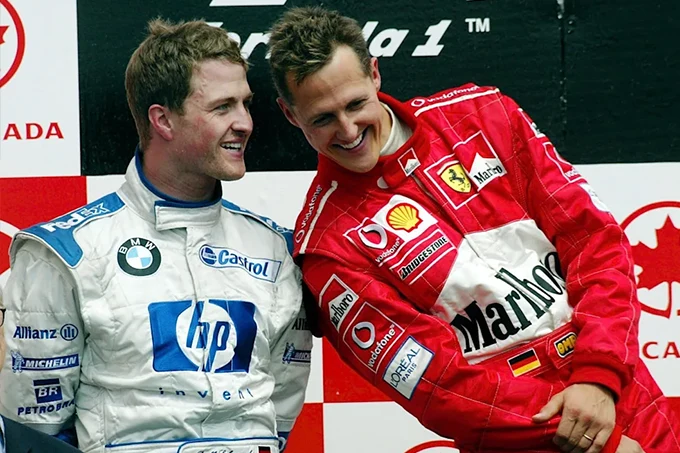
Michael and Ralf Schumacher remain the only brothers to have stood on a Formula 1 podium together, achieving the distinction on 16 occasions.
For Ralf, those shared achievements have become increasingly meaningful with the passage of time.
During their active careers, the demanding schedule and constant competitive pressure made it difficult to fully appreciate the significance of those moments.
Looking back, however, he recognises how extraordinary it was for two brothers to compete successfully at the highest level of motorsport.
Ralf also recalled Michael’s genuine happiness whenever he achieved a strong result or secured a Grand Prix victory.
Despite Michael’s own extraordinary success, he remained proud of his younger brother’s accomplishments.
Their competitive instincts never disappeared, but the rivalry did not undermine their relationship.
Regardless of which brother finished ahead, they could celebrate together after the race.
For Ralf, those experiences remain among the most treasured memories of his Formula 1 career.
Why Schumacher Struggled to Leave Formula 1 Behind
Michael Schumacher announced his retirement at Monza in September 2006, bringing his first Formula 1 career to an end after the season.
His victory at the Chinese Grand Prix on 1 October 2006 was the 91st of his career and would ultimately prove to be his last.
Ralf recalled that retirement had been an exceptionally difficult decision for his brother.
Although Michael wanted to spend more time with his wife and children, he also remained deeply attached to racing and the demanding routine that had structured his life for so many years.
According to Ralf, Michael spent considerable time considering his future before making the decision with his wife.
He remembered receiving a personal telephone call in which Michael informed him that he would stop racing at the end of the season.
However, the reality of retirement proved more complicated than the decision itself.
After years of carefully organised travel, testing, preparation and competition, Michael suddenly found himself without the familiar structure of a Formula 1 season.
Ralf suggested that the transition left his brother uncertain about how to fill his time.
While Michael appreciated aspects of life away from the championship, he never entirely lost his desire to compete.
That unresolved passion eventually contributed to his return with Mercedes in 2010.
Although he competed for another three seasons, Michael never added to his record of 91 Grand Prix victories.
Ralf Schumacher’s Life Beyond His Brother’s Legacy
Ralf Schumacher also reflected on his own identity within Formula 1 and how public perceptions of him have evolved.
Having built a successful Grand Prix career that included multiple victories and podium finishes, he has subsequently established himself as a television analyst with Sky Germany.
He has also become a familiar face in German advertising through his association with a car-buying business.
Ralf finds it amusing that younger generations sometimes recognise him more readily from television advertisements than from his racing career.
He recalled children identifying him as the man who appears in car-buying commercials, leaving their parents to explain that he was once a Formula 1 driver.
Rather than expressing frustration, Ralf said he appreciates remaining a recognisable figure while reaching a new audience.
He also acknowledged that Michael’s influence continues to extend across generations.
As an example, he referred to Sebastian Vettel, who grew up admiring Michael and has spoken about the importance of his childhood hero.
For Ralf, such admiration demonstrates that his brother’s legacy is not limited to championships, statistics or records.
It also encompasses the inspiration he provided to future drivers and the wider public.
Schumacher, Senna and Hamilton Should Be Celebrated, Not Compared
Reflecting on Michael’s extraordinary achievements during the 1990s and 2000s, Ralf Schumacher argued that Formula 1 should move away from attempting to establish definitive comparisons between its greatest champions.
He believes that each exceptional driver should be understood within the context of their own era.
Michael’s achievements, in his view, were unique to his generation, just as Ayrton Senna’s were to his and Lewis Hamilton’s have been to his.
“It was a great era for Michael in F1,” Ralf said.
He described his brother as one of a kind during his decade of dominance, while recognising that Senna and Hamilton possessed similarly exceptional qualities in their respective periods.
“I think we should stop comparing them, and we should appreciate what they have done for us, and for F1, with all their success around the world.”
His comments offer a perspective on a debate that has continued across generations of Formula 1 supporters.
Rather than using championship totals, victories or records to establish an absolute hierarchy, Ralf believes the sport should recognise the individual contributions of its most influential drivers.
For Michael Schumacher, that legacy includes seven world championships, 91 Grand Prix victories, the transformation of Ferrari into a dominant force and a lasting influence on German motorsport.
But for Ralf, the significance of his brother’s career extends far beyond the statistics.
It is also the story of a young driver whose arrival captivated an entire country, a competitor who helped shape a generation of Formula 1, and an older brother whose guidance and support played a fundamental role in his own journey.
Twenty years after Michael’s final victory, Ralf’s message is ultimately one of recognition and appreciation: Formula 1’s greatest champions do not need to be measured against one another for their achievements to remain extraordinary.