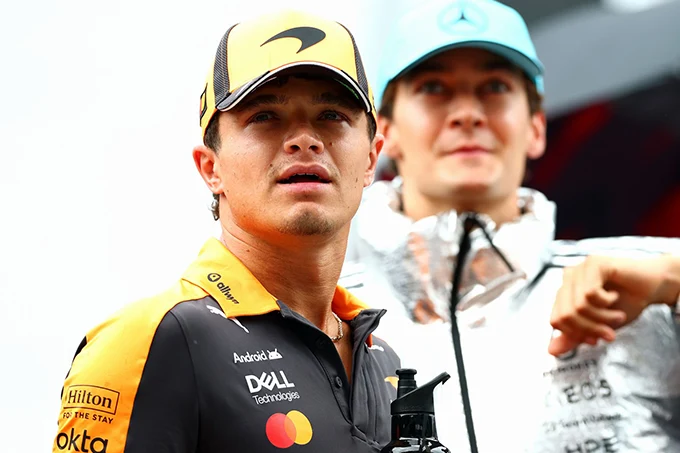
Former Formula 1 driver Juan Pablo Montoya believes McLaren’s internal racing rules contributed directly to the collision between Lando Norris and Oscar Piastri during the Singapore Grand Prix Sprint, arguing that neither driver should be held solely responsible.
Singapore Sprint collision costs McLaren valuable points
McLaren’s controversial Papaya Rules have come under renewed scrutiny following the collision between Lando Norris and Oscar Piastri on the final lap of the Singapore Grand Prix Sprint.
Former Formula 1 driver Juan Pablo Montoya believes the team’s internal racing guidelines played a decisive role in the incident, suggesting that the expectations created by those agreements influenced how both drivers approached their battle.
The collision occurred as the McLaren teammates fought for position in the closing stages of the Sprint. Piastri spun into the barriers, while Norris managed to continue and eventually finished eighth.
The consequences were significant for McLaren. Having been on course to collect nine championship points before the incident, the British team ultimately left the Sprint with just one.
While Norris subsequently faced criticism over his involvement, Montoya argues that assigning responsibility to one driver overlooks the underlying problem within McLaren’s approach to managing its drivers.
Montoya questions the influence of McLaren’s Papaya Rules
Speaking to Spanish publication AS, Montoya suggested that the existence of McLaren’s internal agreements had fundamentally changed the way Norris and Piastri raced against each other.
According to the Colombian, Piastri approached the battle with the expectation that Norris would leave him sufficient room, something Montoya believes would not necessarily have happened in a conventional fight between drivers from different teams.
Montoya argued that without the Papaya Rules, Norris would have been considerably more aggressive and would not have offered Piastri the same opportunity to challenge around the outside.
In his assessment, Norris initially positioned himself alongside his teammate under braking before ending up just behind him, apparently expecting Piastri to concede the position.
Piastri, however, responded by releasing the brakes and attempting to defend his position around the outside, a move Montoya described as particularly aggressive.
The former Williams and McLaren driver believes this difference in expectations was central to the eventual contact.
Rather than two drivers approaching the corner with the same understanding of the limits of their battle, Montoya suggests that each interpreted the situation through the framework of McLaren’s internal agreements.
Norris would have raced differently against another opponent
Montoya also questioned whether Norris would have handled the situation in the same way had he been fighting a driver from a rival team.
He believes Norris would ordinarily have braked late, attacked the inside and allowed his car to run wide on corner exit, effectively denying his opponent the opportunity to remain alongside.
Against Piastri, however, Montoya argues that Norris adopted a more accommodating approach because of the expectations surrounding McLaren’s internal racing policy.
In Montoya’s interpretation, Piastri recognised that restraint and used it to defend his position rather than surrendering the place.
The Colombian suggested that this created an unusual dynamic in which one driver attempted to respect the spirit of the team’s agreements while the other used the same framework to justify continuing the fight.
For Montoya, the incident illustrates how rules designed to encourage fair competition between teammates can also create uncertainty when both drivers are determined to maintain their positions.
Montoya refuses to blame either McLaren driver
Despite his criticism of how the incident unfolded, Montoya does not believe Norris or Piastri should be singled out as responsible for the collision.
His argument is that both drivers were engaged in legitimate racing, with the team’s internal regulations influencing their decisions in ways that ultimately contributed to the contact.
Montoya believes the Papaya Rules can encourage drivers to assume their teammate will avoid contact, potentially creating a false sense of security during close battles.
When an incident then occurs, that expectation can quickly turn into frustration, with each driver believing the other should have acted differently.
From his perspective, the responsibility therefore lies less with either individual and more with the framework McLaren has established for its drivers.
The former F1 driver also played down the severity of the collision itself, treating it as a consequence of two competitive drivers refusing to concede rather than an extraordinary failure of judgment.
McLaren faces questions over its approach to internal racing
The Singapore incident has once again highlighted the difficulties McLaren faces in allowing Norris and Piastri to compete while attempting to protect the team’s collective interests.
The Papaya Rules are intended to establish boundaries for their on-track battles, but Montoya believes the Singapore Sprint demonstrated how those agreements can produce unintended consequences.
His central criticism is that the rules may encourage drivers to make assumptions about how their teammate will behave, rather than responding to the situation as they would against any other competitor.
In Singapore, Montoya believes one driver attempted to race within those expectations while the other exploited the opportunity to maintain his position.
The result was contact, a costly loss of championship points and renewed debate over whether McLaren’s approach is achieving its intended purpose.
For Montoya, the collision was not fundamentally a question of Norris versus Piastri. It was a demonstration of how internal racing agreements can complicate the very battles they are supposed to regulate.
The broader question for McLaren is whether its Papaya Rules provide the clarity its drivers need when racing wheel to wheel, or whether those same agreements are creating expectations that become difficult to reconcile in the heat of competition.