Former Red Bull team principal Christian Horner has revealed that Max Verstappen’s management urged the team to prioritise the Dutchman’s technical requirements during a period of close competition with Sergio Perez, offering fresh insight into Red Bull’s development philosophy and the difficulties faced by Verstappen’s teammates.
Horner acknowledges Red Bull’s approach to its second drivers
Christian Horner has provided a detailed account of how Red Bull’s technical direction increasingly reflected Max Verstappen’s driving preferences, acknowledging that the team’s approach did not always benefit the driver in its second car.
Speaking on the High Performance Podcast, the former Red Bull team principal was asked whether the team had handled its second seat appropriately throughout his tenure.
“Sometimes yes and sometimes no,” Horner admitted, pointing to the lengthy spells enjoyed by Mark Webber, Daniel Ricciardo and Sergio Perez as examples of drivers who established themselves within the team.
Webber spent several seasons alongside Sebastian Vettel, while Ricciardo raced for Red Bull for five years and Perez completed four seasons with the team.
Horner also acknowledged that Pierre Gasly and Alex Albon had been promoted too early, suggesting that their difficulties were partly connected to the demands of competing alongside Verstappen.
Perez’s Red Bull career followed a similar trajectory. After initially establishing himself as a competitive teammate, his performances deteriorated during 2023 and particularly throughout 2024.
For Horner, understanding those struggles requires examining how Red Bull’s cars evolved around Verstappen’s exceptional driving characteristics.
Verstappen’s driving style shaped Red Bull’s technical direction
Horner traced the origins of Red Bull’s increasingly specialised development philosophy to 2018, when Verstappen and Ricciardo were still teammates.
According to Horner, their performances were initially closely matched, with a car that accommodated both driving styles relatively well.
That balance gradually changed as Verstappen became more demanding about the handling characteristics he required.
The Dutchman consistently sought greater front-end responsiveness, allowing him to attack corners aggressively while remaining comfortable with rear-end instability that other drivers found difficult to manage.
Horner described Verstappen as an exceptionally talented driver whose technical demands increasingly influenced the engineering department.
As Red Bull pursued the characteristics that allowed Verstappen to extract maximum performance, its development tools and engineering decisions naturally moved towards producing cars with those qualities.
The consequences became increasingly apparent for his teammates.
Horner cited the 2021 car, the RB16B, and its predecessor during Albon’s tenure as examples of machinery whose handling characteristics proved challenging for drivers unable to replicate Verstappen’s approach.
Horner disputes Perez’s account of Red Bull’s second seat
The former team principal also addressed comments made by Perez during an appearance on the same podcast.
Perez had claimed that Horner told him Red Bull only entered a second car because regulations required the team to do so.
Horner denied making that statement but acknowledged that he had been explicit about the team’s competitive hierarchy when discussing Perez’s arrival.
At the time, Perez was without a confirmed seat and was holding discussions with Sauber about the following season.
Horner explained that he made it clear Red Bull was structured around maximising Verstappen’s chances of winning the World Championship.
Perez would be free to pursue victories when his own on-track performance placed him in a position to win. However, when that was not possible, he would be expected to support Verstappen.
According to Horner, this arrangement reflected Red Bull’s belief that concentrating its efforts around Verstappen offered the strongest opportunity to challenge Mercedes.
He also maintained that Perez willingly accepted those conditions.
Horner suggested that the Mexican was eager to secure a place with a leading team, particularly after believing that his earlier experience at McLaren might have ended his chances of returning to a front-running operation.
Albon’s contribution influenced Red Bull’s 2022 car
Horner then highlighted the role Alex Albon played in developing Red Bull’s first car under Formula 1’s 2022 technical regulations.
While Red Bull remained heavily committed to its 2021 championship campaign, Albon undertook significant behind-the-scenes development work on the following season’s machinery.
According to Horner, Albon’s input helped produce a car suited to a more conventional driving style, closer to those of Perez and Ricciardo.
When the 2022 season began, Verstappen was unhappy with the car’s handling, particularly its understeer.
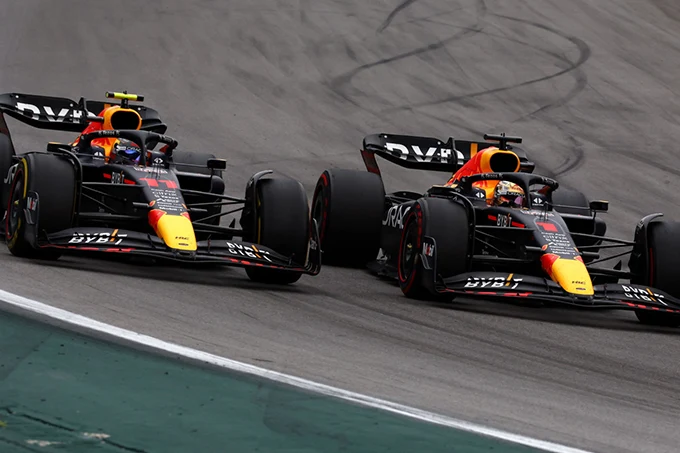
Perez, by contrast, benefited from its more predictable behaviour, allowing him to compete more closely with his teammate during the opening stages of the season.
Horner suggested that this difference in preferences helped explain why the performance gap between the two drivers was initially smaller.
However, his recollection appeared to combine events from two separate seasons.
Although Albon had indeed contributed to the development of Red Bull’s 2022 car before joining Williams, the period when Verstappen and Perez each won two races across the opening four Grand Prix weekends occurred in 2023.
Perez’s victory in Azerbaijan that year brought him level with Verstappen on race wins, setting the scene for a significant discussion between Horner and the Dutchman’s management.
Verstappen’s management demanded a change in development direction
Horner revealed that he met with Verstappen’s management around the Azerbaijan Grand Prix, when Perez’s competitive start had raised questions about the direction of Red Bull’s car development.
According to Horner, Verstappen’s representatives believed the car had been developed around Perez’s preferences rather than those of the reigning World Champion.
Their message was unequivocal: Red Bull needed to focus on what Verstappen required from the car.
Horner acknowledged that the request was clear and explained why the team was receptive to it.
Verstappen was Red Bull’s leading asset and the driver considered most capable of delivering championship success.
From Horner’s perspective, it was therefore natural for an engineering department to gravitate towards the requirements of its fastest driver.
He argued that such decisions were not unique to Red Bull, but reflected the wider tendency of Formula 1 teams to concentrate their development efforts on the driver they believed could deliver the strongest results.
His account confirms that Verstappen’s management actively pushed for a technical direction more closely aligned with the Dutchman’s preferences, although Horner did not detail a specific engineering change implemented immediately after the meeting.
Red Bull’s development tools exposed underlying weaknesses
Beyond the question of driver preference, Horner acknowledged that Red Bull’s technical infrastructure also contributed to the difficulties experienced by its second drivers.
He believes the team’s development process exposed limitations in the correlation between its engineering tools and the behaviour of the car on track.
In particular, Horner identified shortcomings in the reliability and performance of Red Bull’s wind tunnel, alongside weaknesses in certain simulation systems.
Those limitations made it more difficult to produce a car whose characteristics could be consistently understood and exploited by both drivers.
Combined with Verstappen’s unusual ability to handle an aggressive front end and a less stable rear, the shortcomings helped create a persistent difference in performance between the two sides of the garage.
Horner’s explanation suggests that the challenges faced by Red Bull’s second drivers were not simply a matter of individual ability, but also reflected the interaction between car development, technical limitations and driving style.
Hadjar still faces the Verstappen performance gap in 2026
Horner believes the consequences of that development philosophy remain visible in Red Bull’s current driver pairing.
Despite praising Isack Hadjar’s performances during the 2026 season, he acknowledged that a significant difference remains between what the Frenchman can extract from the car and the performance Verstappen is capable of delivering.
Horner described Hadjar’s work this year as outstanding, while maintaining that Verstappen’s ability to exploit the car’s characteristics continues to set him apart.
His comments underline a recurring challenge that has followed Red Bull through several driver partnerships, from Ricciardo and Albon to Perez and now Hadjar.
For Horner, the performance disparity cannot be explained solely by the identity of Verstappen’s teammate.
It also reflects a long-standing technical philosophy shaped by the Dutchman’s exceptional abilities, the engineering direction adopted to maximise them and the limitations of Red Bull’s development tools.
The revelations offer a more detailed explanation of why Red Bull repeatedly struggled to achieve comparable performance from both cars, while acknowledging that its decisions were ultimately guided by the pursuit of championship success with Verstappen.