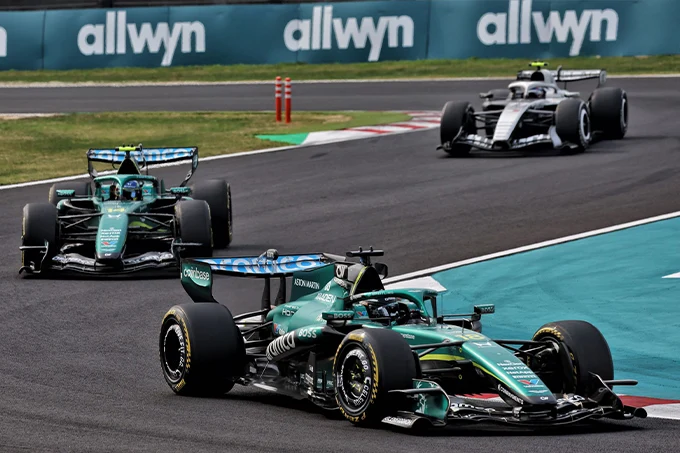
Honda believes the Mexican Grand Prix could expose new weaknesses in Formula 1’s 2026 power units, with the removal of the MGU-H creating additional challenges for turbochargers operating at high altitude.
Formula 1’s return to Mexico City presents an unfamiliar technical challenge for engine manufacturers, as the sport’s new-generation power units prepare to race at more than 2,200 metres above sea level for the first time.
Honda has warned that the unique conditions at the Autódromo Hermanos Rodríguez could affect every power unit manufacturer, potentially forcing teams to impose operating restrictions if their turbochargers encounter difficulties.
Situated 2,285 metres above sea level, the circuit experiences air density approximately 25 per cent lower than at sea level. This forces turbochargers to operate at higher speeds to deliver the airflow required by the combustion engine.
Until 2025, the MGU-H helped compensate for these conditions by providing electrical assistance to the turbocharger, improving boost response and reducing turbo lag.
However, its removal under the 2026 technical regulations means manufacturers must now manage those demands without the system’s assistance.
Honda chief engineer Shintaro Orihara believes the consequences could extend across the grid.
“This is the first time we are running in Mexico with these engines, and last year we had the MGU-H, so we had some assistance from it, but this year we don’t have it,” Orihara explained.
“It’s quite a big challenge. For example, at idle, we had assistance from the MGU-H to generate boost pressure, but this year we have no assistance at idle.”
Orihara suggested that the potential difficulties would not be limited to Honda.
“I think it’s not only Honda, but all power unit manufacturers that will face difficulties in terms of power with these engines. But it’s not only about power.”
Turbocharger Limits Could Force Engine Restrictions
One of Honda’s principal concerns is the additional demand placed on the turbocharger by Mexico City’s reduced air density.
With less oxygen available in the surrounding atmosphere, the turbocharger must work harder to supply sufficient airflow to the engine.
That raises questions about whether manufacturers can maintain the necessary boost pressure without approaching the turbocharger’s operating limits.
“In Mexico, the turbocharger speed is quite high to obtain the necessary airflow,” Orihara explained.
“We will have to check that, but in the worst case, we might have to impose some restrictions on engine operation.”
Despite those concerns, Honda’s preparations have suggested that the altitude should have little influence on electrical energy management.
“We have carried out a lot of testing on the dyno, and we think there will be almost no impact on energy management, but we need to verify that during free practice.”
Asked why turbo lag could remain a concern despite the higher turbocharger speeds required at altitude, Orihara pointed to the mechanical limitations of the system.
“The turbocharger has certain limits in terms of operating speed,” he said.
However, he indicated that Honda had potential solutions available and was not currently concerned about exceeding those limits.
Honda Encouraged by Austin Progress
The Mexican Grand Prix also offers Honda an opportunity to assess improvements made following its recent efforts to address turbo lag.
The manufacturer has encountered challenges with turbocharger response since introducing its second and third performance gains under Formula 1’s Additional Development and Upgrade Opportunities (ADUO) system, in Spain and Azerbaijan respectively.
However, developments evaluated during the United States Grand Prix provided encouraging results.
“In Austin, we worked on measures to counter turbo lag, and we confirmed their effects on that phenomenon,” Orihara explained.
“The results were quite positive for us before coming here.”
Honda’s development programme continues at its Sakura facility in Japan, where engineers are working to optimise engine performance and improve turbocharger response.
“At Sakura, the teams are also continuing to work hard to optimise power, and they are continuing their research into ways of improving turbo lag.”
Nevertheless, Orihara stressed that the Mexican Grand Prix would provide an important opportunity to establish whether those improvements translate effectively to high-altitude conditions.
“It will be very important to see how our turbo behaves during free practice, but I’m certain this doesn’t concern only Honda, but the other manufacturers as well.”
Honda has already attempted to reproduce the demands of the Mexican circuit through extensive testing at its Japanese facility.
“We carried out dyno testing at Sakura to simulate the conditions in Mexico, so we have some idea of what is going to happen,” Orihara said.
“But because we have never physically run at high altitude with this power unit, it will be very interesting to see how our turbocharger behaves.”
First Real-World Test of the 2026 Engines at Altitude
Mexico’s opening practice sessions will therefore represent an important validation exercise for Honda and the other power unit manufacturers.
Although simulation and dyno testing have provided an indication of the challenges involved, the new engines have yet to operate in the circuit’s demanding conditions.
For Honda, the priority will be determining whether the turbocharger can consistently deliver the required boost pressure while remaining within its operating limits.
The uncertainty is particularly significant given the absence of the MGU-H, which previously provided additional support in precisely these circumstances.
While Honda remains encouraged by its preparations and recent progress, Mexico will provide the first real-world indication of how Formula 1’s 2026 power units respond to one of the most demanding environments on the calendar.