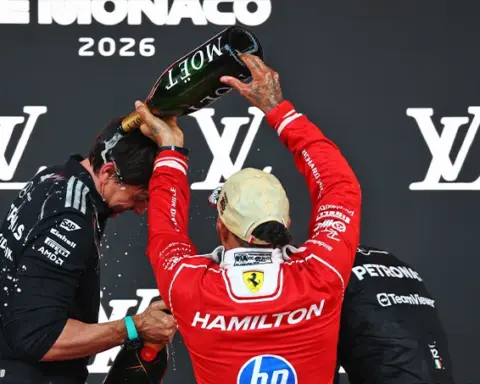
Lewis Hamilton has revealed why he ignored Ferrari’s strategic instructions during the Singapore Grand Prix, a split-second decision that cost him a likely podium finish.
Speaking in Austin ahead of the United States Grand Prix, the seven-time world champion admitted his mistake but insisted he would not abandon the approach that has defined his career: challenging conventional thinking and searching for opportunities to win.
Hamilton appeared on course for a third-place finish in Singapore before opting to remain on track during a Virtual Safety Car period, despite Ferrari instructing him to pit.
While teammate Charles Leclerc made his stop, Hamilton continued, hoping an alternative strategy could deliver a stronger result. Instead, the decision backfired, leaving the 41-year-old sixth at the chequered flag.
Hamilton apologised to Ferrari over team radio immediately after the race and subsequently described the experience as a “painful lesson” on social media.
Having been excused from his post-race media duties in Singapore because he was feeling unwell, Thursday’s press conference in Austin provided his first opportunity to explain the incident in detail.
Hamilton admits the mistake was difficult to accept
The Ferrari driver acknowledged that the disappointment remained with him for several days, although he believes the experience should serve as a lesson rather than a reason to fundamentally change his approach.
“First and foremost, you learn from these kinds of experiences. It’s rare that I find myself in a situation like that. Of course, I didn’t feel particularly good for the two days afterwards, but you live and you learn,” Hamilton explained.
His decision, however, was not simply the result of an impulsive reaction during the race. According to Hamilton, the desire to explore alternative strategies had been present before the Grand Prix even began.
“Third place wasn’t enough for me”
Hamilton explained that his determination to fight for victory influenced his thinking from the moment he arrived on the starting grid.
“When I lined up on the grid, knowing I was going to be third, I was already looking, as I always do, for ways to win. I’m always looking to potentially do something different, and I wanted to run a different strategy rather than simply follow Charles and drive around behind each other.”
Ferrari’s pre-race simulations had suggested that second and third places were achievable. The team also anticipated that Max Verstappen could potentially have greater pace.
For Hamilton, however, securing the projected result was not his primary objective.
“We thought Max might potentially be quicker, and the strategy projections were suggesting second and third. But that wasn’t enough for me. I wanted to have different options and see what might be possible.”
One possibility involved extending the opening stint if the medium tyres proved sufficiently durable.
“If the medium tyres lasted longer, we might have been able to extend the first stint further. But once the race started, that wasn’t the case, and the feeling wasn’t good during that opening stint.”
The strategy therefore began to unravel earlier than Hamilton had anticipated.
Traffic behind Leclerc complicated Hamilton’s race
Hamilton’s difficulties continued when he emerged behind Leclerc after his pit stop.
Despite running on the faster soft compound, Hamilton found himself losing valuable time behind his teammate, who was using the slower tyre that Hamilton had started the race on.
The situation reminded him of a similar experience earlier in the season at the Dutch Grand Prix.
“Then, obviously, I came out behind Charles and ended up losing a lot of time while he was on a slower tyre, the one I had used at the beginning, while I had pace on the softs. It was perhaps a somewhat similar scenario to Zandvoort.”
That frustration formed part of the circumstances surrounding the decisive strategic call later in the race.
A split-second decision under the Virtual Safety Car
The critical moment arrived when the race was neutralised under Virtual Safety Car conditions.
Ferrari instructed Hamilton to pit, but the Briton chose to stay out, uncertain whether Leclerc would also be stopping.
Hamilton admitted that he had almost no time to evaluate the situation and realised his mistake virtually immediately.
“I was approaching the pit entry and I didn’t know whether Charles was going to stop, because I think he had done so not long before. In a split second, I decided to stay out.”
“As soon as I reached the pit entry, I realised it was probably the wrong decision. But I acknowledged it, took responsibility for it, and you have to move on.”
The consequences were significant.
What had appeared to be a likely podium finish became a sixth-place result, denying Hamilton and Ferrari valuable championship points.
Importantly, Hamilton did not attempt to shift responsibility onto Ferrari’s pit wall. He accepted that the decision to disregard the instruction had been his own.
Hamilton refuses to stop challenging Ferrari
Despite acknowledging the mistake, Hamilton made clear that the experience would not persuade him to follow every strategic decision without question.
The seven-time world champion believes his responsibilities at Ferrari extend beyond driving the car. He sees challenging established methods and questioning decisions as an essential part of helping the team improve.
Hamilton confirmed that discussions had taken place internally following Singapore, with both sides examining how their collaboration could become more effective.
“We’ve had good discussions internally about how we can work better together and improve our collaboration. But I don’t think anything has changed regarding the quality of the work we’re doing together behind the scenes.”
He also defended the philosophy that has guided his approach throughout his career.
“I genuinely believe that my job, rather than always following what is planned, is to continually challenge the team, myself included, and constantly question established ways of doing things.”
“Ultimately, that’s what has allowed me to get to where I am, and I’m not going to give up that approach.”
For Hamilton, taking calculated risks and questioning conventional decisions remain part of the process of pursuing better results, even when those choices occasionally prove costly.
Lost points for Ferrari remain Hamilton’s biggest regret
Although missing out on a likely podium was personally disappointing, Hamilton emphasised that the greater frustration came from losing points for Ferrari in the Constructors’ Championship.
He acknowledged that his decision had consequences beyond his own finishing position and stressed the collective responsibility shared between driver and team.
“Sometimes it doesn’t work out, and this was one of those moments. But there will be other opportunities to fight, and we win and lose as a team. So we carry the weight and consequences of those decisions together.”
Hamilton also admitted that costing Ferrari points was particularly difficult to accept.
“It really hurts when I cost the team points. It’s not something that happens to me very often, but I’m going to work twice as hard to make sure it doesn’t happen again.”
His message ahead of the United States Grand Prix was therefore one of accountability without abandoning ambition.
Hamilton accepts that his decision in Singapore was wrong and recognises the impact it had on Ferrari’s result. Nevertheless, he remains convinced that questioning strategies, exploring alternatives and refusing to settle for projected results are essential to his efforts to help bring the Scuderia back to the top.