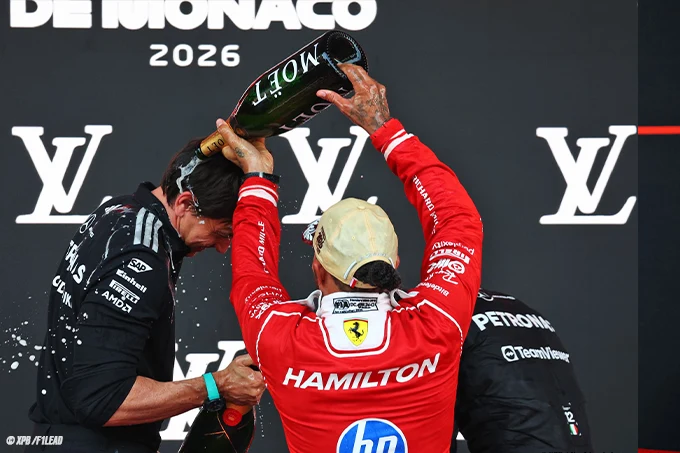
Mercedes team principal credits Hamilton’s relentless pursuit of perfection with teaching him to recognise mistakes, challenge his behaviour and embrace personal change
Toto Wolff has revealed how his 12-year partnership with Lewis Hamilton transformed his approach to leadership, admitting that the seven-time world champion taught him the importance of recognising mistakes and actively changing his behaviour.
Beyond their extraordinary success together at Mercedes, Wolff believes Hamilton’s constant pursuit of improvement fundamentally challenged his understanding of management and personal development.
The Austrian has also outlined how he is preparing for an eventual transition in the leadership of the Formula 1 team.
A partnership that defined an era of Formula 1
Lewis Hamilton’s move to Ferrari at the beginning of the 2025 season brought an end to one of the most successful driver-team partnerships in Formula 1 history.
Hamilton joined Mercedes in 2013 after leaving McLaren, at a time when Toto Wolff was also assuming significant responsibilities within the German manufacturer’s management structure.
Their collaboration became central to an unprecedented period of success for Mercedes.
Between 2014 and 2020, Hamilton secured six Drivers’ World Championships with the team, while Mercedes claimed eight consecutive Constructors’ Championships from 2014 through 2021.
During that period, Hamilton established himself as the most successful driver of his generation in terms of Grand Prix victories, while Wolff emerged as one of the most influential figures in the Formula 1 paddock.
However, their working relationship extended far beyond the years of championship dominance.
The pair also experienced some of the most difficult moments of their respective careers, including the controversial conclusion to the 2021 championship, when Hamilton lost the world title at the final race of the season.
Mercedes subsequently faced further challenges following the introduction of Formula 1’s new technical regulations in 2022.
Despite those setbacks and Hamilton’s eventual departure, Wolff continues to acknowledge the profound influence the British driver had on him, both professionally and personally.
Hamilton’s pursuit of perfection changed Wolff’s perspective
Wolff explained that one of Hamilton’s defining characteristics was his determination to continuously improve, regardless of his achievements or experience.
The Mercedes team principal believes that attitude taught him an important lesson about the possibility of personal change.
“There’s something I learned from Lewis Hamilton: he has such a strong sense of perfection that he constantly maintains an internal feedback loop. How can I improve? Every single day.”
For Wolff, Hamilton’s approach demonstrated that even the most accomplished individuals should never consider themselves beyond further development.
“We know that perfection is impossible to achieve because our goals also keep changing. But he’s an adult, and he taught me that, contrary to what we might think, we are not finished products.”
That philosophy challenged Wolff’s previous understanding of how personality and behaviour evolve over time.
Rather than accepting established habits as permanent characteristics, Hamilton’s example encouraged him to recognise that individuals can continue changing throughout their lives.
Learning to recognise mistakes and change behaviour
Wolff believes people often develop a fixed perception of their own personalities as they gain experience.
Over time, individuals become familiar with their strengths, weaknesses and established patterns of behaviour, sometimes assuming that certain characteristics cannot be changed.
“We think: okay, we have strengths and weaknesses, we have our personality, this is how we behave.”
“Either we’re tyrants within our organisation, or we adopt a more welcoming and caring management style.”
According to Wolff, Hamilton helped him challenge that rigid view of human behaviour.
The British driver’s approach demonstrated that recognising mistakes should be followed by a deliberate effort to change, rather than simply accepting those mistakes as an inevitable consequence of personality.
“He taught me that if you realise you’ve made the wrong decisions, or perhaps behaved in the wrong way, then change.”
“And if you actively try to change, you will change.”
For the Mercedes team principal, the lesson was particularly relevant to leadership.
Hamilton’s influence reinforced the importance of questioning personal decisions and management behaviour, even after years of experience at the highest level of motorsport.
Wolff considers the future of Mercedes leadership
Alongside his reflections on Hamilton’s influence, Wolff also discussed the eventual transfer of his leadership responsibilities at Mercedes.
The Austrian has been considering how the team’s management structure could evolve when he decides to step away from his current executive role.
Bradley Lord is among the potential figures mentioned in connection with a future leadership transition, although Wolff has not identified a definitive successor.
Two years ago, Wolff decided to remain in charge for several more years.
However, he has continued evaluating how the organisation should operate when that transition eventually takes place.
“There will be a strong management structure when I do it. I’ve realised that it can’t be done abruptly,” Wolff explained.
His preference is for a carefully planned transition rather than a sudden transfer of authority to a single individual.
Responsibilities could be shared between two or three executives
Wolff indicated that his current responsibilities may eventually be divided among several senior figures within Mercedes.
Rather than concentrating every aspect of leadership in one successor, he is assessing individuals who already contribute to the organisation in different areas.
“I think my responsibilities will be divided between two or three people whom I’m currently evaluating and who, in my opinion, are already doing an excellent job, each bringing their own strengths in different areas.”
The proposed structure would allow Mercedes to distribute management responsibilities according to the specific expertise of those involved.
Wolff acknowledged that such a transition would inevitably change how the team operates, but expressed confidence in its ability to remain competitive.
“Of course, things will be different, but the team will perform.”
Wolff could combine an executive transition with a non-executive chairmanship
Although Wolff is considering stepping away from his current responsibilities, he does not envisage a complete separation from Mercedes while his family retains an ownership interest in the organisation.
He suggested that the future structure could involve a combination of executive management and a non-executive chairman.
“A complete break is probably not realistic if my family and I remain owners of the business.”
“So it’s possible that we move towards a structure combining executive functions and a non-executive chairmanship.”
However, Wolff stressed that any such arrangement would require clearly defined responsibilities.
He believes that remaining involved at ownership or board level while simultaneously interfering with everyday management decisions would undermine the effectiveness of the new leadership structure.
“But that has to be defined extremely precisely. Because you can’t remain in the background while interfering in day-to-day management.”
For Wolff, establishing those boundaries would be an essential part of ensuring a successful transition.
Hamilton’s influence extends beyond their years together
Although Hamilton and Wolff now represent different Formula 1 teams, their 12-season partnership continues to influence the Mercedes team principal’s approach to leadership.
Their collaboration produced six Drivers’ Championships for Hamilton and contributed to Mercedes’ eight consecutive Constructors’ titles, but Wolff considers the personal lessons equally significant.
Hamilton’s commitment to questioning his own performance and pursuing improvement demonstrated to Wolff that experience does not eliminate the need for self-reflection.
That principle remains relevant as the Austrian evaluates his own management style and prepares the organisation for a future leadership transition.
While no definitive succession arrangement has been announced, Wolff has made clear that he wants Mercedes to retain a strong management structure, with responsibilities distributed appropriately and clear boundaries between executive leadership and any future non-executive role.