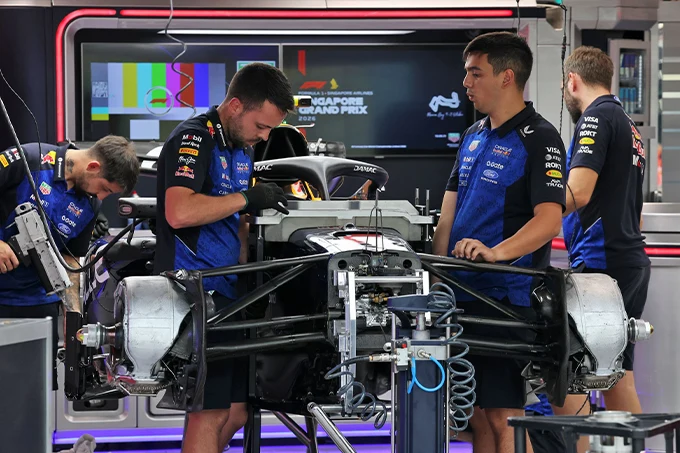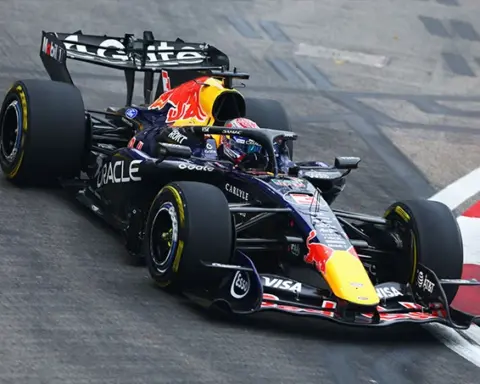
Red Bull Powertrains has emerged as a competitive force in its first Formula 1 season, but technical chief Ben Hodgkinson believes the DM01 power unit still has significant performance to unlock through improved calibration, combustion development and closer integration with the chassis.
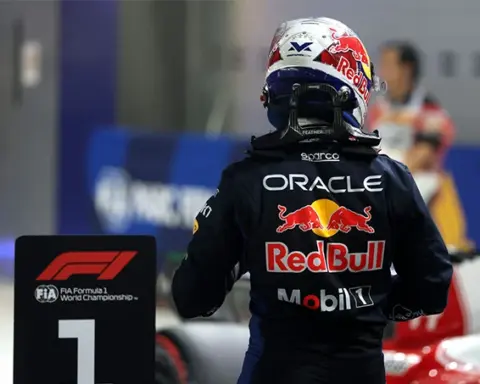
Red Bull’s remarkable resurgence in the 2026 Formula 1 season has highlighted the potential of its first in-house power unit. Consecutive victories for Max Verstappen in Malaysia and Singapore, increasingly competitive straight-line speed and an internal combustion engine regarded by the FIA as a benchmark have demonstrated the strength of Red Bull Powertrains’ debut project.
Yet the engineers responsible for developing the DM01 insist that the power unit remains some distance from its ultimate potential.
Red Bull technical director Pierre Waché has assessed the project’s maturity at just four or five out of ten, suggesting that the team still has substantial development opportunities despite its recent success.
The explanation lies partly in the distinction between the engine’s theoretical performance and Red Bull’s ability to extract that performance consistently.
According to Red Bull Powertrains technical director Ben Hodgkinson, the recent improvement has not necessarily come from producing more outright power. Instead, the team has made considerable progress in understanding and optimising the performance already available within the existing engine architecture.
A development decision that compromised early preparation
The origins of Red Bull’s power unit progress can be traced back to a decision taken before the 2026 championship began.
The manufacturer had originally intended to freeze the engine’s technical specification sufficiently early to dedicate the final months of preparation to endurance testing, reliability work and calibration.
However, the performance achieved during development did not meet the engineering team’s expectations.
Rather than finalising the specification as planned, Red Bull Powertrains elected to continue improving the engine, accepting that the decision would reduce the time available for testing and optimisation.
Hodgkinson explained that this compromise had a direct impact on the team’s preparations.
“At the point when we had originally planned to freeze the specification, we weren’t really satisfied with the performance level,” he explained.
“We therefore decided to continue developing, which left us with less and less time for endurance testing and all the necessary calibration work.”
The consequences became apparent when the season began.
“We started the season with calibrations that were still relatively immature. But they have improved race after race.”
Red Bull had developed an engine with considerable performance potential, but its ability to deliver that performance consistently was initially limited by the maturity of its control systems and operating parameters.
An ambitious combustion system presents a complex challenge
One of the principal difficulties has been the sophisticated combustion system at the heart of the DM01’s V6 internal combustion engine.
According to Hodgkinson, the pursuit of maximum performance resulted in a design that is particularly demanding to operate consistently at its optimum.
“In trying to design the most powerful engine possible, we ended up with a combustion system that is quite difficult to operate consistently at its optimal level,” he explained.
“That placed considerable pressure on the calibration team.”
In modern Formula 1, power unit calibration extends far beyond determining how much power the combustion engine produces.
Engineers must coordinate several closely connected variables, including power delivery, fuel consumption, energy recovery and electrical energy deployment.
Under the 2026 technical regulations, the increased contribution of electrical propulsion has made the relationship between these systems even more important.
A setting that improves one area of performance can introduce compromises elsewhere, requiring engineers to find an effective balance between efficiency, energy management and outright speed.
For Red Bull Powertrains, the challenge has been particularly significant because the combustion system’s characteristics make it difficult to reproduce its theoretical peak performance under all operating conditions.
A breakthrough between Baku and Sepang
Although Red Bull’s understanding of the DM01 has improved progressively throughout the championship, Hodgkinson identified the period between the Azerbaijan and Malaysian Grands Prix as particularly important.
The advances made during that interval helped the team extract more consistent performance from its existing power unit, contributing to Red Bull Powertrains’ first Formula 1 victory at Sepang.
Crucially, those improvements did not require the introduction of a new hardware specification.
“We have an engine that sometimes delivers less than we know it is capable of,” Hodgkinson explained.
“We have always had that perspective: if we can get it operating at the peak of its capabilities on every lap, we will be in a really good position.”
The statement illustrates the distinction between increasing an engine’s maximum theoretical output and improving the consistency with which that output can be achieved.
Red Bull’s recent competitiveness suggests that its engineers are making meaningful progress towards the latter objective.
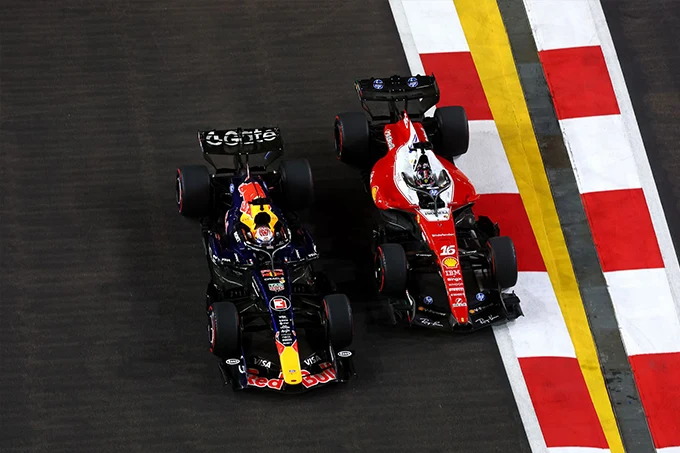
The approach also differs from Ferrari’s development path. According to the technical analysis, Ferrari has benefited from additional development opportunities available under the ADUO mechanism, while Red Bull’s recent improvements have been achieved without introducing a revised power unit hardware specification.
That distinction is significant: Red Bull has been able to improve its competitive position through calibration and operational understanding rather than relying exclusively on physical changes to the engine.
Closer chassis and power unit integration delivers further gains
The improvements have not been confined to the engine department.
Hodgkinson also highlighted a stronger working relationship between Red Bull’s chassis engineers and its power unit specialists, with both groups increasingly coordinating their development efforts.
“There is now much closer collaboration between the chassis and engine teams,” he explained.
“It’s about finding the right energy balance, determining where to recover and deploy energy, and working with the drivers.”
The closer integration allows engineers to tailor the power unit’s operating characteristics more precisely to the car’s aerodynamic performance, handling behaviour and the demands of individual circuits.
Energy recovery and deployment strategies are particularly important under the current regulations, where the interaction between electrical power and the combustion engine can have a substantial influence on overall lap time.
Decisions about when to harvest energy, when to deploy it and how to distribute available power must therefore be considered alongside the characteristics of the chassis.
The collaboration also helps explain why Red Bull’s recent aerodynamic improvements and power unit gains appear to have complemented one another.
Rather than developing the two elements independently, the team is increasingly treating them as parts of a single performance package.
Significant performance remains available through calibration
Despite Red Bull’s recent victories, Hodgkinson believes the DM01 still operates below its theoretical optimum.
The team’s dynamometer testing indicates that additional performance remains available, particularly through further refinement of the engine’s calibration.
“I think there is still a lot to gain through calibration,” Hodgkinson said.
“Our engine still has some margin compared with its theoretical optimum, as we see it on the test benches.”
That assessment supports Waché’s earlier suggestion that Red Bull’s power unit project remains at a relatively early stage of maturity.
However, Hodgkinson acknowledged that software and calibration improvements alone will not resolve every limitation.
Certain characteristics of the combustion system itself will also need to evolve if the engine is to become easier to operate consistently at its maximum potential.
The challenge is therefore both operational and architectural: improving the current engine’s settings while identifying changes that could make future versions more manageable.
A combustion system described as a ‘diva’
Hodgkinson offered a particularly revealing description of the DM01’s combustion characteristics.
“Our combustion system could be described as something of a diva,” he said.
“We need to make it a little easier to work with to get the best out of it.”
The comparison reflects the difficulty of extracting maximum performance from a system designed around ambitious technical targets.
While the combustion concept has demonstrated considerable capability, its sensitivity places additional demands on the engineers responsible for managing it.
Red Bull’s objective is not simply to increase its peak output, but to make that performance more accessible and repeatable across different circuits and operating conditions.
Achieving that consistency could provide further competitive benefits even without a substantial increase in the engine’s maximum power.
The 2027 regulations offer an opportunity to refine the design
Red Bull Powertrains is already applying the lessons of its debut season to the next phase of the engine programme.
Regulatory changes planned for 2027, including revisions concerning fuel flow and boost pressure, will require manufacturers to reassess aspects of their power unit designs.
For Red Bull, those changes represent an opportunity to address some of the combustion system characteristics that have complicated calibration during 2026.
Hodgkinson confirmed that the team’s future development plans are directly influenced by its experience of operating the DM01.
“The changes we are preparing for next year come from everything we have learned about how to get the best out of this combustion system,” he explained.
The objective will be to retain the engine’s competitive strengths while improving the ease and consistency with which its performance can be delivered.
That could reduce the compromises engineers currently face when balancing combustion efficiency, power delivery and electrical energy management.
Red Bull’s first engine is already winning, but its development is far from complete
Red Bull Powertrains’ first Formula 1 season has already produced an important achievement: an independently developed power unit capable of winning Grands Prix.
The victories in Malaysia and Singapore have demonstrated that the DM01 can compete at the front of the field, while its straight-line performance has reinforced the credibility of the project.
Nevertheless, Hodgkinson’s assessment suggests that Red Bull has yet to fully exploit the capabilities of its existing technology.
The decision to extend engine development before the season compromised early calibration work, but also produced a combustion system with substantial underlying potential.
As the campaign has progressed, improved calibration, more effective energy management and closer cooperation between the chassis and power unit departments have helped unlock that performance.
Further refinements remain possible during the current development cycle, while the planned 2027 changes provide an opportunity to address the combustion system’s more demanding characteristics.
For Red Bull, the significance of its recent success therefore extends beyond two consecutive victories.
Its first in-house Formula 1 power unit has already demonstrated race-winning capability, and the engineers responsible for it believe they are still learning how to extract its full potential.