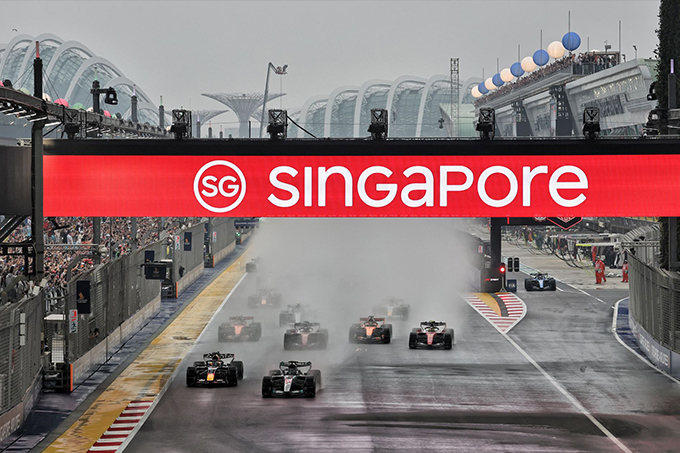
The former Ferrari and McLaren driver believes Formula 1 has become too reluctant to race in the rain and questions the decision to interrupt the start procedure in Malaysia.
Former Formula 1 driver Gerhard Berger has strongly criticised the championship’s approach to wet-weather racing, arguing that excessive caution is depriving drivers of the opportunity to demonstrate their skills in difficult conditions.
The Austrian, who raced for Ferrari and McLaren during his Formula 1 career, believes the sport has increasingly moved away from racing in heavy rain, with delayed starts and Safety Car procedures becoming more common.
Berger also questioned the handling of technical problems during last weekend’s Bahrain Grand Prix in Malaysia, suggesting that teams which had avoided the issues should not necessarily have been disadvantaged by problems affecting their rivals.
Berger questions the interrupted start procedure at Sepang
Speaking to Austrian newspaper Kronen Zeitung, Berger called for a clearer understanding of what caused the technical difficulties that disrupted the start procedure at Sepang.
The 67-year-old believes it is important to distinguish between problems attributable to the FIA and those originating within individual teams.
He noted that not every driver appeared to have experienced the same difficulties.
« I heard Alonso say that he had absolutely no problems, » Berger said.
« So the question is whether it was even justified to interrupt the start procedure. »
Berger argued that reliability and technical preparation are fundamental aspects of Formula 1 competition, and that teams which successfully manage their systems should not automatically suffer because others encounter difficulties.
He pointed to Red Bull’s work on its internal combustion engine as an example of the importance of technical execution.
« I absolutely don’t understand why a team that does a better job, as Red Bull did with its internal combustion engine, for example, should be penalised for it. »
« Technical problems happen, but if a few teams managed to get everything working properly at Sepang, then you simply have to start with fewer cars, as happened at Indianapolis in 2005. »
Berger was referring to the controversial 2005 United States Grand Prix, when only six cars started after the Michelin-equipped teams withdrew over tyre safety concerns.
His comments raise questions about how Formula 1 should balance sporting fairness with the consequences of technical failures affecting multiple competitors.
‘When it rains, we don’t race anymore’
Berger was even more outspoken about the way Formula 1 now handles wet-weather conditions.
He believes the championship has gradually become unwilling to allow drivers to compete on heavily wet circuits, increasingly relying on Safety Car starts or waiting until conditions improve significantly.
According to Berger, this approach risks removing one of the defining challenges of Grand Prix racing.
« Over the past two years, wet-weather racing has been pushed into the background in a way that is not worthy of Formula 1, » he said.
« Either we start behind the Safety Car, or we wait until the track has dried sufficiently to run on slick tyres. »
« We’re heading towards what happens in the United States: when it rains, we don’t race anymore. »
His criticism reflects his belief that wet-weather competition should remain an essential part of Formula 1 rather than something routinely avoided.
Berger fears F1 is losing a test of driver skill
For Berger, racing in difficult weather conditions has historically been one of the clearest ways for drivers to demonstrate their ability.
He believes that reducing the amount of genuine wet-weather racing also makes Grands Prix less unpredictable, removing opportunities for smaller teams and less-fancied drivers to achieve unexpected results.
« It used to be a real challenge for drivers, who could demonstrate their talent in the most difficult conditions, » Berger explained.
« On top of that, races became more unpredictable, which also gave the outsiders a chance. »
« But with the way things are being managed today, it’s becoming more and more of a farce. »
Berger’s remarks underline his frustration with what he sees as an increasingly cautious approach to race management.
While Formula 1 must account for the risks associated with poor visibility, standing water and difficult track conditions, the former Grand Prix winner believes the sport is losing an important element of its competitive identity.
His criticism comes during a Singapore Grand Prix weekend already affected by heavy rain, bringing the debate over wet-weather racing procedures back into focus.