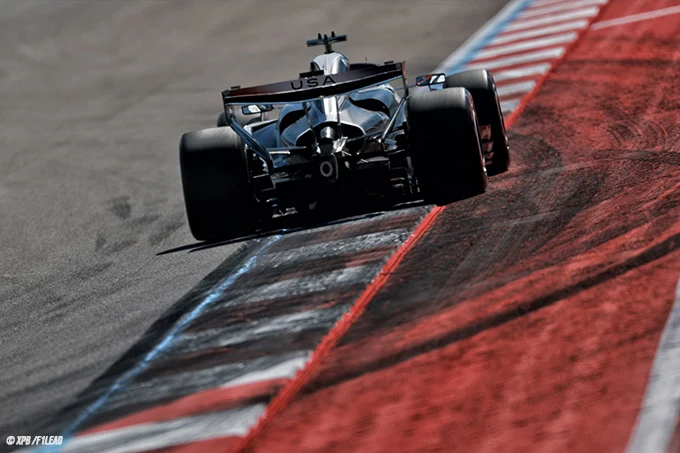
Track limits have emerged as a major concern at the 2026 United States Grand Prix, with 207 lap times deleted across Friday’s two free practice sessions at the Circuit of the Americas.
A total of 23 drivers were affected, highlighting the widespread difficulties of staying within the track boundaries.
While these infringements carry limited consequences during practice, they could have a far greater impact in qualifying and the race. Williams driver Alex Albon and McLaren’s Lando Norris were among the worst affected.
Track limits have once again become a significant talking point at Austin, where several demanding sequences of corners continue to challenge drivers attempting to maximise performance.
During Friday’s FP1 and FP2 sessions, race officials recorded a remarkable 207 deleted lap times for track limits violations. The infringements involved 23 drivers, demonstrating that the problem extended well beyond a handful of competitors pushing particularly hard.
In free practice, however, such deletions carry relatively minor consequences. Drivers use these sessions to explore the limits of their cars, experiment with different racing lines and establish how aggressively they can approach the circuit boundaries without breaching the regulations.
When a driver exceeds those boundaries, the lap time is simply deleted. The consequences could become considerably more serious during Saturday’s qualifying session and Sunday’s race.
Albon topped the list of offenders on Friday. The Williams driver, already struggling with a difficult car, accumulated 20 track limits violations across the two sessions.
That figure underlines the challenges he faced in keeping his car within the circuit boundaries while attempting to extract performance.
Norris was not far behind. The McLaren driver had 18 lap times deleted throughout Friday, placing him among the most frequent offenders.
Together, Albon and Norris accounted for 38 of the 207 deleted lap times recorded during the day.
At the opposite end of the list, Valtteri Bottas demonstrated considerably greater consistency. The Cadillac driver committed just one infringement across both sessions, recorded during FP2.
Bottas and Esteban Ocon were also the only two drivers who participated in both sessions to complete at least one of them without a single lap time deletion.
The figures illustrate just how difficult respecting track limits has become across the field at the Circuit of the Americas.
Qualifying and Race Penalties Could Prove Costly
Although Friday’s 207 infringements had no major sporting consequences, the situation could change dramatically in qualifying.
A deleted lap at a crucial moment can determine whether a driver progresses to the next stage of the session or faces an early elimination.
A competitor who sets a time quick enough to advance could still find themselves knocked out if that lap is subsequently invalidated for exceeding track limits.
The situation also presents an important challenge for race officials, who must ensure that all relevant infringements are reviewed and correctly processed before the field progresses from Q1 to Q2 and subsequently from Q2 to Q3.
Any delay or inconsistency in applying the regulations could create an unfair situation in which a driver loses a place in the next qualifying segment.
The consequences can be equally significant during the race, where repeated track limits violations may result in time penalties.
Under the regulations described for the weekend, a driver receives a black-and-white warning flag after three infringements. A fourth violation can then trigger a five-second time penalty.
With so many violations already recorded during practice, drivers will need to exercise greater caution to avoid compromising their race results.
Teams will also have to examine the sections of the circuit where their drivers are experiencing the greatest difficulties, allowing them to identify potential adjustments and reduce the risk of further infringements during the competitive sessions.
Austria 2023 Remains a Warning
Despite the substantial number of deleted lap times at Austin, Friday’s figures remain well below the extraordinary situation witnessed at the 2023 Austrian Grand Prix.
At the Red Bull Ring, officials recorded more than 1,200 track limits infringements during the race, creating an exceptionally complicated situation for those responsible for enforcing the regulations.
The volume of incidents required an extensive review of the violations recorded throughout the Grand Prix.
Several penalties were eventually imposed after the chequered flag, resulting in significant changes to the final classification.
That race remains one of Formula 1’s most striking examples of the difficulties that can arise when track limits regulations become a major factor in the outcome of a Grand Prix.
The 2026 United States Grand Prix has not yet experienced anything approaching those proportions.
Nevertheless, the 207 deleted lap times recorded during Friday’s practice sessions represent a clear warning ahead of qualifying and the race, when the consequences of exceeding track limits could be considerably more severe.
Austin 2026 – Track Limits Violations (FP1 & FP2)
| Driver | FP1 | FP2 | Total |
|---|---|---|---|
| Albon | 9 | 11 | 20 |
| Norris | 5 | 13 | 18 |
| Hadjar | 4 | 11 | 15 |
| Leclerc | 5 | 10 | 15 |
| Hamilton | 4 | 10 | 14 |
| Bortoleto | 5 | 8 | 13 |
| Antonelli | 4 | 9 | 13 |
| Bearman | 4 | 8 | 12 |
| Hulkenberg | 9 | 2 | 11 |
| Piastri | 1 | 10 | 11 |
| Sainz | 4 | 6 | 10 |
| Russell | 5 | 3 | 8 |
| Colapinto | 3 | 5 | 8 |
| Gasly | 4 | 3 | 7 |
| Stroll | 3 | 3 | 6 |
| Alonso | 1 | 4 | 5 |
| Lindblad | 2 | 3 | 5 |
| Lawson | 1 | 4 | 5 |
| Verstappen | 1 | 2 | 3 |
| Herta | 3 | – | 3 |
| Ocon | 2 | 0 | 2 |
| Pérez | – | 2 | 2 |
| Bottas | 0 | 1 | 1 |