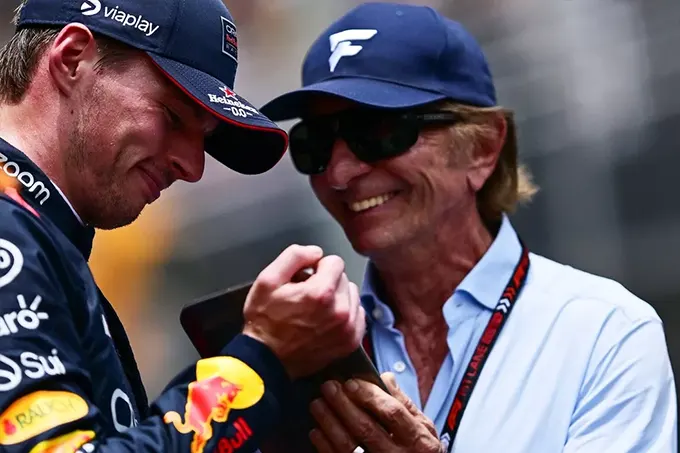
Two-time Formula 1 world champion Emerson Fittipaldi has expressed his amazement at how dramatically the relationship between drivers and engineers has changed, admitting that he would never have tolerated the constant radio instructions that have become commonplace in modern motorsport.
The Brazilian, who won the world championship in 1972 and 1974, believes technological advances have transformed Formula 1 into a more reliable, sophisticated and competitive championship.
However, while he admires the precision of modern engineering and the abilities of today’s drivers, he admits that the level of communication and technical guidance would have been difficult for him to accept during his own racing career.
Modern Formula 1 Cars Are More Reliable Than Ever
Fittipaldi believes one of the most significant improvements in Formula 1 has been the extraordinary increase in mechanical reliability.
Although the current regulations have introduced fresh technical challenges, the former McLaren driver considers modern cars far more dependable than those he raced during the 1970s.
Speaking to Betway, Fittipaldi pointed to the Malaysian Grand Prix as an unusual example of reliability problems caused by challenging weather conditions.
“Malaysia is a specific example because of the significant influence of the water. It seems they didn’t expect so much water to get inside,” he explained.
Nevertheless, he believes advances in electronics have fundamentally changed the sport.
“Generally speaking, electronics make the cars more reliable than ever. In the seventies, eighties and nineties, we retired much more frequently because of mechanical problems. The cars are much more reliable nowadays.”
For Fittipaldi, the transformation extends well beyond reliability, with modern technology allowing teams to monitor and analyse almost every aspect of a car’s performance.
Data Analysis Has Completely Transformed Driver Feedback
Fittipaldi is particularly impressed by the extraordinary amount of information available to modern Formula 1 engineers.
Unlike previous generations, today’s teams can examine detailed telemetry to understand exactly how a driver approaches every corner.
“Thanks to all the analysis available to engineers, they know every centimetre of the circuit and exactly what the driver is doing,” he explained.
“They can see the steering position, the throttle pedal, precisely how much pressure the driver applies to the brake pedal in every corner and how that braking pressure develops.”
Such detailed analysis would have been almost unimaginable during Fittipaldi’s championship-winning years.
The Brazilian recalled how differently he would have reacted to an engineer attempting to scrutinise his driving technique.
“If someone had come to me in my day and said they wanted to check my braking curve at the end of the straight, I would have laughed at them!”
“Everything has become so much more precise nowadays.”
‘I Would Have Told the Engineer to Shut Up’
Despite his admiration for modern technology, Fittipaldi remains astonished by the amount of information drivers are expected to process while racing.
He believes contemporary drivers have developed an almost computer-like ability to absorb instructions without losing concentration.
“Drivers nowadays practically have a chip in their heads,” he remarked.
Fittipaldi has witnessed this first-hand while following his son, Emerson Fittipaldi Jr., in Formula 2 and listening to his radio conversations.
“I follow my son in Formula 2 and listen to his team radio. I hear his engineer giving him instructions from corner to corner about brake balance.”
For the former world champion, that degree of intervention would have been unacceptable.
“In my day, I would have told that engineer to shut up! I can’t drive when someone is constantly talking to me.”
Fittipaldi acknowledges, however, that modern drivers have grown up in an entirely different environment.
“But this new generation has been growing up with it since karting. Their brains are like little computers.”
Technology Has Narrowed the Gap Between Drivers
Fittipaldi believes the combination of sophisticated data analysis, constant engineering support and advanced driver preparation has helped make modern Formula 1 more competitive.
With access to detailed performance comparisons and technical feedback, drivers can identify weaknesses and improve their techniques more efficiently than in previous generations.
As a result, he believes the gap between experienced front-runners and less accomplished competitors has become smaller.
“It is much easier nowadays for drivers to reach the same level, but if someone has genuine talent, they still stand out from the rest.”
For Fittipaldi, technology has not eliminated the importance of natural ability.
“You can still recognise natural talent. But the differences are much smaller nowadays, and the field is much more evenly matched.”
He considers that greater competitive balance a positive development for Formula 1, particularly from the spectators’ perspective.
McLaren’s Engineering Operation Illustrates F1’s Evolution
As a McLaren ambassador, Fittipaldi has gained insight into the scale of the engineering operations supporting modern Formula 1 teams.
He highlighted the number of specialists involved in analysing performance during race weekends, as well as the additional personnel working remotely from team headquarters.
“I know they have around 20 engineers at the circuit and another 35 to 40 engineers at the factory who are constantly receiving live data.”
“There are also simulator drivers who continue driving at the factory during the night.”
According to Fittipaldi, such extensive technical operations are no longer exclusive to Formula 1’s leading teams.
“All the teams do this nowadays. That brings the entire field closer together, and that’s fantastic for the spectators.”
Natural Talent Still Makes the Difference
Although Fittipaldi admits he would struggle with the constant communication and detailed technical supervision expected of modern drivers, he recognises the extraordinary abilities required to succeed in today’s Formula 1.
The sport has evolved from an era in which drivers relied heavily on instinct and relatively limited technical feedback into one where every aspect of performance can be measured, analysed and refined.
Yet the Brazilian remains convinced that exceptional drivers will always distinguish themselves, regardless of how advanced the technology becomes.
For Fittipaldi, the greatest transformation is not simply the sophistication of modern Formula 1 machinery, but the remarkable capacity of today’s drivers to combine natural talent with an unprecedented level of technical information.