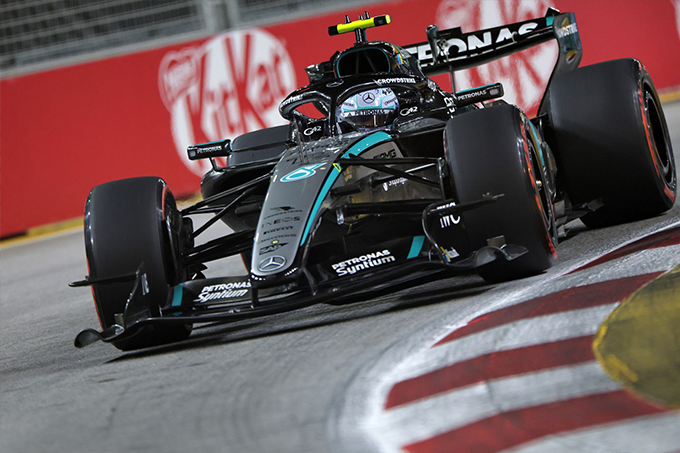
Mercedes’ latest Formula 1 upgrades, introduced at Sepang during last weekend’s Bahrain Grand Prix, have left the team facing serious questions about its development direction. Rather than delivering an improvement, the new package may have cost the car between three and five tenths of a second per lap.
The consequences were immediate. During Friday’s practice sessions in Singapore, Mercedes decided to conduct a direct comparison between its old and new specifications. George Russell continued with the previous package, while Andrea Kimi Antonelli tested the latest developments.
However, Mercedes subsequently removed the new front wing from Antonelli’s car ahead of sprint qualifying.
The sprint qualifying results only added to the team’s concerns. Antonelli qualified seventh, while Russell secured second place.
Wolff defends Mercedes’ development approach
Is Mercedes’ aerodynamic department facing a crisis? Speaking in the Singapore paddock, Toto Wolff defended the team’s decisions and explained why comparing the two specifications had become necessary.
« The complication is that we brought a major upgrade, but Sepang is such a tricky circuit and somewhat unusual in terms of temperatures and the deteriorating asphalt that we didn’t know whether the upgrade wasn’t working as expected or whether it was being affected by the track conditions.
« That’s why we decided to come to Singapore with two different car specifications and see what happened, knowing that Singapore is also an unusual circuit.
« So we carried out that exercise during practice. »
What conclusions had Mercedes drawn from its first day of running?
« There is a trend, but the most important thing is to really break down what works and what doesn’t work on the old and new specifications, then find a way forward, take the best elements and establish where our development direction needs to go to extract the optimum lap time.
« That said, running two different cars is obviously not always ideal, but it’s a compromise we have to accept. So we have two test drivers. We have to accept that to make sure we’re making the right decisions going forward. »
Wolff remained cautious when asked whether Mercedes’ latest upgrades had failed to deliver, particularly following the decision to remove Antonelli’s new front wing before sprint qualifying.
« There is a similar trend. The new car seems to be a little trickier to drive.
« I’m not saying it’s necessarily slower, because there are good things in it, but perhaps we haven’t yet found a way to put everything together and set it up properly.
« The old car is a little more stable and has more grip, but this is really just one data point. It’s only one practice session, and we’ll need more time to reach more conclusive findings. »
Why the upgrade problems could affect Mercedes’ 2027 car
The latest developments were intended to lay the foundations for Mercedes’ 2027 challenger. The difficulties encountered in Malaysia have therefore raised concerns extending well beyond the current season.
Asked whether resolving these problems was essential to ensuring a strong start to 2027, Wolff acknowledged the importance of the situation.
« It’s very important. We’ve incorporated several months of development into the car, clearly pointing in a direction that offers an advantage, and perhaps we just need to calibrate it a little to find the right path for 2027. »
Could Mercedes’ upgrade strategy be part of the problem?
Mercedes’ approach to introducing upgrades has also come under scrutiny.
Unlike Ferrari, which has spread its developments across several stages, Mercedes opted to introduce a substantial package at a single Grand Prix.
The disadvantage of this approach is that when the package fails to deliver the expected improvement, identifying which individual component is responsible becomes considerably more difficult.
Wolff accepted that this was a legitimate concern.
« Yes, that’s a fair point.
« We’re one of those large organisations that has to be very careful about how and when we spend money under the cost cap.
« We felt the right strategic decision was to work on a bigger upgrade before introducing it.
« Obviously, the risk is that if it doesn’t work as expected, it’s quite difficult to go backwards and understand why it hasn’t worked.
« So that’s something we’ll look at in the future, perhaps taking smaller steps so that if there’s a warning sign, it’s easier to reverse course.
« But there isn’t an obvious answer at this stage because, until now, it has worked. »
Wolff also recalled previous occasions when major developments had failed to produce the intended results.
« I remember 2022, which went well. We had a second and a half that we were putting on the car, and it backfired.
« But since then, every upgrade we’ve brought to the car… remember Montreal, which was a great success and worked extremely well.
« If this one hasn’t worked, why? That’s the fundamental question.
« If we come to the conclusion that it hasn’t delivered what we expected, then obviously we’ll have to reflect on that for the future. »
Ten years after his championship triumph, why Wolff still admires Nico Rosberg
The Bahrain Grand Prix at Sepang also brought back painful memories for Mercedes.
Ten years earlier, Lewis Hamilton suffered an engine failure at the Malaysian circuit, an incident that ultimately contributed to his defeat in the 2016 World Championship battle against team-mate Nico Rosberg.
A decade after Rosberg claimed his only Formula 1 world title, Wolff reflected on their relationship and the German driver’s achievements since retiring from racing.
« There aren’t many Formula 1 drivers, apart from Niki, that I know who have managed to reinvent themselves in a completely different career.
« I see Nico a lot. I have enormous respect for him. We’re friends.
« He’s created a venture capital fund that is one of the most successful. He dedicates himself to it 24 hours a day, seven days a week.
« He’s incredibly hardworking and highly respected in the technology industry.
« I’m happy to have invested in it and to be involved, and you really have to take your hat off to what he’s achieved since leaving the sport. »
Reflecting on the intense 2016 championship battle, Wolff admitted that he would handle certain situations differently with the experience he has gained over the past decade.
« Looking back at that 2016 season, I wish I’d had the additional ten years of experience that I have now, because there are a few small things I would have managed differently and perhaps avoided some of the controversy.
« Particularly at the final race, where we tried to micromanage a situation that didn’t need to be micromanaged. That was my fault.
« So yes, ten years. It’s crazy how quickly time passes. It feels like it was five years ago, but we’ve moved on.
« My relationship, and the team’s relationship, with Lewis is as strong as it possibly can be while we’re rivals on track, and the same applies to Nico. »